
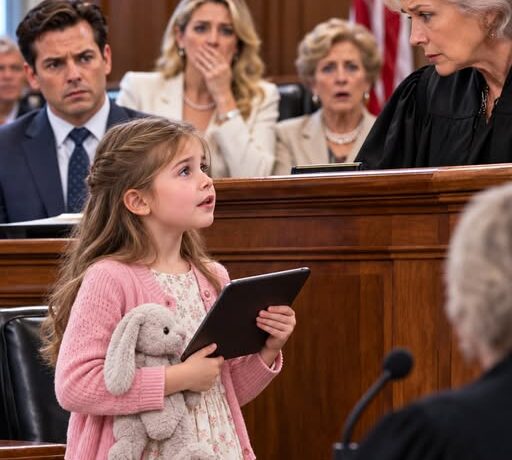
He walked into that courtroom smiling, with his mother, his girlfriend, and an expensive lawyer beside him. I walked in alone with three folders and ten years of skills he had forgotten I ever had. But none of us knew what our little girl had hidden in the pocket of her pink cardigan.
Part 1
The day my husband took me to court, he wore the same gray suit he had worn at our wedding.
I don’t think it was an accident. Derek always liked symbols. He liked things that looked meaningful from the outside. When he caught my eye across the courtroom and gave me a slow, satisfied smile, I understood exactly what that suit meant.
I started this marriage in this suit. I’m ending it in this suit too.
Derek Harlow wanted the house. He wanted our savings. And he wanted full custody of our six-year-old daughter, Sophie.
His petition described a woman I had never met. According to the papers his lawyer had filed, I was emotionally unstable, financially irresponsible, and prone to “explosive outbursts in front of the minor child.” I had “abandoned my professional responsibilities” and “become entirely dependent on Mr. Harlow while contributing nothing to the household.” The phrase that stuck with me most was buried on page four:
Respondent is not a safe or stable parent.
I had read that line so many times the night before that the words had stopped looking like words.
Now I sat at the respondent’s table in my navy dress, my hands folded on top of three thick folders, and listened while a man in a two-thousand-dollar suit explained to a judge that I was a danger to my own child.
Behind Derek, in the first row, sat his mother, Margaret. Pearls, cream blazer, silver hair set that morning at the salon. Every few minutes she touched a tissue to the corner of her eye. Her eyes were completely dry.
“My son only wants peace,” she murmured, just loud enough for the people around her to hear. “That’s all he’s ever wanted.”
Peace.
That was the word they had been using for months.
Peace was Derek quietly emptying our joint savings account two weeks before he filed. Peace was me standing at the grocery checkout with Sophie beside me while my debit card was declined three times. Peace was the phone call from the credit card company telling me my name had been removed as an authorized user.
Peace was Margaret kneeling in front of my daughter at a family dinner and saying, in her sweetest voice, “Mommy gets confused sometimes, sweetheart. That’s why Daddy has to make the big decisions.”
And sitting right beside Derek, close enough that their shoulders nearly touched, was Brooke Calloway.
Officially, Brooke was the office manager at Derek’s company, Harlow Building Solutions. Today she had been introduced as “a close family friend who has observed the household.” She wore a soft blue sweater and a concerned expression.
She also wore a thin diamond tennis bracelet.
I knew that bracelet. Eight months earlier, I had found it in a velvet box in the glove compartment of Derek’s car while looking for the registration. I had smiled, put it back, and spent two weeks waiting for an anniversary gift that never came.
Now it sparkled on her wrist every time she reached over to touch his arm.
Part 2
Judge Eleanor Price was in her early sixties, with short silver hair, reading glasses on a beaded chain, and the steady, unhurried manner of someone who had heard every lie a family could tell. She turned a page in the file and looked at me over her glasses.
“Mrs. Harlow. I see no attorney listed for you today.”
“I’m representing myself, Your Honor.”
Derek made a small sound, almost a laugh. His lawyer, Raymond Kessler, didn’t bother to hide his smile.
“You understand you are entitled to counsel,” the judge said.
“I do, Your Honor. The retainer I paid was returned when the check bounced. My husband closed the account it was drawn from the following morning.” I kept my voice even. “I’ve documented that as well.”
The judge’s eyebrows rose a fraction. She wrote something down.
“Very well. We’ll proceed.”
I knew what everyone in that room thought of me. Derek thought I had come alone because I had no one. Kessler thought I was quiet because I was frightened. Margaret thought I was about to be erased.
None of them seemed to remember who I had been before I became Sophie’s mother.
Before Sophie, I spent ten years as a forensic accountant at one of the largest firms in the state. My job was to follow money people were desperate to hide. I’d testified in fraud cases, embezzlement cases, and two divorces far uglier than mine. I left the firm when Sophie was born because she arrived six weeks early and spent her first month in the NICU, and after that, I couldn’t imagine handing her to anyone else for ten hours a day.
Derek had called it “a nice little break.” Over the years, the break became a story he told people. Natalie used to work. As if it was something I had dabbled in, like pottery.
He had forgotten that a skill like mine doesn’t go away just because you stop getting paid for it.
The night he moved out, he left his home office laptop behind, assuming I would never think to look at it. I didn’t touch his passwords or his email. I didn’t have to. Our joint tax returns, the bank statements mailed to our home, the public filings for his company, and the business records the law required him to disclose in the divorce were more than enough.
For four months, after Sophie fell asleep each night, I sat at the kitchen table with a legal pad and a spreadsheet, and I followed every dollar.
I found all of it.
But I knew something Derek didn’t. Numbers prove theft. They don’t always prove character. A judge could hear that a man moved money and still decide he was a good father.
And what Derek had done went far beyond money.
Over those same four months, my bright, chatty little girl had gone quiet. She started asking permission before she spoke. She came home from her weekends with her father and went straight to her room. When I asked her what was wrong, she would look at the floor and say, “Nothing, Mommy. I’m not allowed to talk about grown-up stuff.”
I didn’t know yet what that meant.
I was about to find out.
Part 3
Halfway through the morning, the side door opened, and Mrs. Patel, the guardian ad litem the court had appointed for Sophie, walked in holding my daughter’s hand.
Sophie wore the pink cardigan my mother had knitted for her before she passed. It was buttoned one hole off, so one side hung lower than the other. Under her arm she clutched Mr. Buttons, the gray stuffed rabbit she’d slept with every night since she was two.
She looked so small in that big room that it physically hurt to see.
Her eyes went to me first. I smiled at her, as gently as I could.
Then she looked at her father.
Derek’s smile changed. It went tight at the edges. He leaned slightly forward, and his lips moved, barely, without sound.
Remember what we practiced.
I saw it. I’m almost sure Mrs. Patel saw it too.
Sophie’s fingers sank deep into Mr. Buttons’ fur. She looked down at her shoes.
Mrs. Patel guided her to a chair beside her own, a few feet from the bench, and gave her a coloring book and a box of crayons. Sophie didn’t open them. She just sat there with her hand pressed flat against the pocket of her cardigan, as though something inside it might jump out.
And for the first time that morning, I saw something I had never once seen on my husband’s face.
Fear.
Kessler rose, buttoned his jacket, and spoke the way men speak when they have never lost an argument they cared about.
“Your Honor, the facts here are simple. Mr. Harlow owns a successful business. He has stable income, a suitable residence, and a strong family support system. Mrs. Harlow, by contrast, has no income, no attorney, and, as you’ll hear, a documented pattern of erratic behavior in front of the child.”
“Erratic,” I repeated quietly.
He smiled at me. “We have witness statements.”
Margaret rose before she was even called, like an actress who’d been waiting in the wings. She was sworn in and settled into the witness chair, smoothing her skirt.
“I hate saying this,” she began, in a voice that suggested she had been looking forward to it for weeks. “But I’ve seen her scream at my son in front of that little girl. I’ve seen her throw dishes. Once she locked herself in the bathroom for nearly three hours while Sophie cried outside the door.”
“Mrs. Harlow,” the judge said to me, “you’ll have the chance to respond.”
“Thank you, Your Honor. I’d like to respond to that now, if I may.” I stood. “I did lock myself in the bathroom. It was the night Derek changed the lock on our bedroom door and told me I could sleep on the couch until I ‘learned my place.’ Sophie wasn’t crying outside the door. She was inside with me. We were reading Goodnight Moon in the bathtub with a blanket because it was the only room in the house with a lock on my side.”
The courtroom went quiet.
Derek sighed and shook his head, the picture of a weary, patient man. “Natalie, please. Don’t do this here.”
There it was. The performance. The gentle husband, wounded by his hysterical wife. I’d watched him do it at parties, at his mother’s house, in front of our neighbors. He was very good at it.
Brooke leaned toward him and whispered something. Under the table, he squeezed her hand.
But not quite low enough.
I saw it. And from the way Judge Price’s pen paused, so did she.
Part 4
“Mrs. Harlow,” the judge said, “do you have evidence to support your position?”
“I do, Your Honor. Bank records, business ledgers, and copies of messages that were produced in discovery.”
Kessler was on his feet before I’d finished. “Objection. We were never properly served with any of this.”
I opened the first folder and took out a single printed page.
“Mr. Kessler’s office was served electronically last Friday at 4:12 p.m.,” I said. “His assistant replied confirming receipt at 4:19. Here’s the confirmation.”
I walked it to the clerk, who handed it up to the bench.
Kessler blinked. He looked down at his own notes, then at Derek. Derek wasn’t smiling anymore.
Judge Price read the page and set it aside. “Overruled. Go ahead, Mrs. Harlow.”
So I did.
I didn’t raise my voice. I didn’t need to. I simply walked the court through it, one page at a time, the way I had walked juries through fraud cases a decade earlier.
Seventy-two thousand dollars transferred from our joint savings, in amounts carefully kept under ten thousand each, into an account opened under the name Margaret Ellison. Margaret’s maiden name.
Forty-one thousand dollars in “consulting fees” paid by Harlow Building Solutions to a company called BC Strategic Partners, registered to a Mr. Tyler Calloway. Brooke’s younger brother. A company with no website, no employees, and an address that turned out to be a mailbox store.
A one-year lease on a two-bedroom apartment downtown, paid entirely from marital funds, beginning eight months before Derek filed for divorce.
And a business loan application, signed by Derek four months earlier, on which he had checked the box stating he had no dependents.
“He told the bank he had no children,” I said, “so his debt-to-income ratio would look better. Six weeks later, he told this court he wanted full custody of one.”
With each page, the courtroom seemed to grow a few degrees colder. Margaret had stopped dabbing at her eyes. Brooke was very still.
But Derek recovered faster than I expected. Arrogance had always been his second language.
“Numbers can be made to say anything,” he said, leaning back in his chair. “That’s literally what she used to do for a living. Twist numbers. This is exactly what I’m talking about, Your Honor. This is why Sophie needs stability. With me.”
At the sound of her name, Sophie flinched in her chair.
Judge Price noticed. She set down her pen.
“I’d like to hear from the guardian ad litem now.”
Part 5
Mrs. Patel began to rise.
Before she was fully standing, a small hand went up beside her.
Sophie. Arm straight in the air, the way she’d been taught in kindergarten. Mr. Buttons squeezed under her other elbow.
The entire courtroom stopped.
Judge Price’s whole face softened. She leaned forward on her elbows.
“Yes, sweetheart? Do you want to say something?”
Sophie swallowed. Her eyes were shining, but when she spoke, her voice came out clearer than I had heard it in months.
“May I show you something that Mommy doesn’t know about, Your Honor?”
My breath stopped in my chest.
Something Mommy doesn’t know about.
I looked at Derek. The color was leaving his face so quickly it was almost like watching water drain from a glass.
“Sophie,” he snapped. Sharp. The voice he used when no one else was around. “Sit down. Now.”
Judge Price’s head turned toward him slowly.
“Mr. Harlow. You will not speak to that child. One more word in that tone, and the bailiff will escort you out of my courtroom. Do you understand me?”
Derek’s jaw worked. “Yes, Your Honor.”
The judge looked at Mrs. Patel, who nodded and knelt beside Sophie, one hand on her back.
“Go ahead, Sophie,” the judge said gently. “What would you like to show me?”
Sophie reached into the pocket of her pink cardigan and pulled out a phone.
Not a toy. A real phone, old and scratched, in a purple case covered in unicorn stickers. I recognized it immediately. It was Derek’s old phone. When he’d upgraded last year, he wiped it, disconnected the service, and gave it to Sophie so she could watch cartoons over Wi-Fi during her weekends at his apartment.
It still had a camera. He’d forgotten that.
“I recorded it,” Sophie whispered. “Because Daddy said nobody ever believes little kids. So I wanted you to see it with your eyes.”
Kessler stood up. “Your Honor, we object to any purported recording being—”
“Sit down, Mr. Kessler,” Judge Price said, without looking at him. “The guardian ad litem will take the device. If it contains evidence that a child has been coached in a matter before this court, I am certainly going to see it. You can make your arguments about weight later.”
Mrs. Patel took the phone carefully, as if it were made of glass. She looked through it for a few seconds and her face changed. She brought it up to the bench and connected it to the courtroom screen with the clerk’s help.
Then she went back and sat beside my daughter and held her hand.
When the video began to play, the entire courtroom fell completely silent.
Part 6
At first the screen showed only darkness and a sliver of light. Then the image steadied. Sophie must have tucked the phone behind a pillow on her bed, leaving just enough of the lens uncovered. The frame was tilted. In the corner, I could see the edge of the purple bedspread Derek had bought for his apartment.
Derek’s voice came before his face.
“Say it again. You tell the judge that Mommy screams. That she scares you. Do you understand me?”
The camera shook slightly.
“But she doesn’t scream,” said a tiny voice. My daughter’s voice. “I don’t want to tell a lie.”
Derek walked into the frame. He crouched down so his face was level with hers, and he smiled, and it was the worst smile I had ever seen.
“It’s not a lie, it’s a story. And it’s a story that helps Daddy. Don’t you want to live with Daddy? If you say the right words, Daddy gets to keep the big house. Grandma will get you a puppy. Any puppy you want.” He tilted his head. “But if you don’t say it, Mommy’s going to be very sad. And it’ll be your fault. You don’t want to make Mommy cry, do you?”
Somewhere behind me, someone in the gallery gasped.
Then Margaret’s voice cut in from somewhere off-screen, crisp and cold.
“Good girls who love their fathers do what they’re told, Sophie. That’s what family means.”
My hands went numb. I gripped the edge of the table to keep them still.
On the screen, Derek stood up and began pacing across the small bedroom.
“And listen to me. You don’t talk about Brooke. Not to the judge, not to the lady with the glasses, not to Mommy. You don’t talk about this apartment. You don’t talk about money. Ever. Grown-up things are not your business. Understand?”
“Okay, Daddy.”
Then a third voice. Light, amused, coming from the doorway.
Brooke stepped into frame holding a glass of wine and leaned against the doorframe, laughing.
“Relax, babe. You’re scaring her. By next month, Natalie will be completely broke and we’ll have custody. She won’t fight. She never fights. She’ll fold like she always does.”
Derek laughed too.
The video ended there. A frozen frame of the two of them laughing in my daughter’s doorway.
Nobody in the room moved.
I looked over at Sophie. She was staring down at Mr. Buttons, her lower lip trembling. I wanted to run to her so badly my whole body ached, but I stayed still. I knew she needed this room to see that she’d done something brave, not something wrong.
Judge Price slowly removed her reading glasses and let them fall against her chest on their beaded chain.
When she spoke, her voice was very quiet. That was what made it frightening.
“Mr. Harlow. Stand up.”
Part 7
Derek rose. His legs didn’t seem to want to hold him.
“Your Honor, that—that was taken completely out of context. We were role-playing. She’s six, she doesn’t understand what she—”
“I understood it perfectly well,” the judge said. “Every word.”
Mrs. Patel leaned down and whispered to Sophie. A moment later, my daughter slid off her chair and walked across the courtroom to me. She didn’t look at her father. She climbed into my lap, and I wrapped both arms around her and pressed my face into her hair. She smelled like strawberry shampoo and crayons.
“Did I do it right, Mommy?” she whispered.
“You did it perfectly,” I whispered back. “I’m so proud of you.”
Judge Price’s voice turned hard and flat.
“Mr. Harlow, what I have just watched is an adult attempting to coach a minor child to give false testimony in a custody proceeding. Combined with the financial evidence presented this morning, it appears you have concealed marital assets, misled this court, made false statements to a financial institution, and attempted to intimidate a child witness. Your own child.”
Kessler put a hand on Derek’s arm. “Derek. Stop talking. Right now.”
But Derek was coming apart, and he couldn’t stop.
“She set this up! Can’t you see that? Natalie did this. She’s been poisoning my daughter against me for months—”
“Mrs. Harlow didn’t know this recording existed,” Judge Price said. “Your daughter told us so. Before anyone in this room knew what was on it.”
I set Sophie gently on the chair beside me, kept one hand on her back, and opened my third and final folder.
“No, Derek,” I said. “I didn’t poison anything. You poisoned your own case.”
I handed the clerk the rest of it. A complete financial report with every transfer traced and cross-referenced. Notarized summaries. Bank trails. And a sworn statement from Linda Osei, the bookkeeper who had worked at Harlow Building Solutions for eleven years.
Linda had knocked on my door three weeks earlier, on a rainy Tuesday night, shaking so badly she couldn’t hold the mug of tea I gave her. Derek had ordered her to delete the BC Strategic Partners invoices from the company system. She’d refused. He fired her two days later and told her no one in the industry would ever hire her again.
“I have a daughter too,” she’d told me at my kitchen table. “I couldn’t let him do it.”
She had brought printed copies of everything.
Judge Price read the first few pages of Linda’s statement. Her mouth pressed into a thin line. She turned another page, then another.
Then she set the folder down and looked directly at my husband.
Part 8
“Effective immediately,” Judge Price said, “temporary sole legal and physical custody of the minor child is awarded to the mother, Natalie Harlow.”
I felt Sophie’s small hand slip into mine.
“Mr. Harlow will have supervised visitation only, at a court-approved facility, pending a full psychological evaluation and further order of this court. The paternal grandmother, Margaret Ellison Harlow, will have no unsupervised contact with the child.”
Margaret made a strangled sound in the front row.
“All accounts identified in Mrs. Harlow’s report are frozen as of today. I am ordering an independent forensic audit of Harlow Building Solutions. Mr. Harlow will pay Mrs. Harlow’s reasonable attorney’s fees going forward, so that she can retain counsel of her choosing, along with temporary spousal and child support in an amount to be set this afternoon.”
She paused.
“And this recording, along with the financial documents, will be referred to the county prosecutor’s office for review.”
Kessler closed his eyes.
Derek stood perfectly still, staring at the frozen frame still showing on the screen, as if he could will it to disappear.
Then Margaret began to cry. Real tears, this time. Judge Price looked down at her without sympathy.
“Mrs. Harlow, I would advise you to speak with an attorney of your own. Attempting to influence a child witness carries consequences in this state, regardless of a person’s age or relationship to the child.”
Brooke didn’t wait for the hearing to end. She picked up her purse and walked out the side door without looking back. The bracelet glinted once as the door swung shut behind her.
As the bailiff called a recess, Derek finally looked at me. For a moment, I think he expected me to gloat. I didn’t. I just looked back at him until he turned away.
Then I picked up my daughter, rabbit and all, and carried her out of that courtroom.
Sophie didn’t say anything until we were in the car. I buckled her into her booster seat and climbed in beside her in the back, and we just sat in the parking garage for a while.
“Mommy?”
“Yes, baby?”
“Are you mad I didn’t tell you?”
I turned so I could see her face. “No. Not even a little bit. But can you tell me why you didn’t?”
She picked at Mr. Buttons’ ear. “Daddy said if I told you about the practicing, you’d be so sad you’d get sick. And then the judge would take me away from both of you, and I’d have to live with strangers.” Her chin wobbled. “And Grandma said good girls keep family secrets.”
I had to look out the window for a second.
“Who taught you to hide the phone?”
“Nobody. I saw it in a cartoon. A girl puts her tablet behind a pillow to catch her brother stealing cookies.” She looked up at me. “Daddy kept saying nobody believes kids. So I thought if the judge could see it, she’d have to believe me.”
“She did believe you,” I said. “Everybody in that room believed you.”
“Is Daddy going to jail?”
I thought carefully before I answered. I had promised myself I would never do to her what her father had done. I would never make her carry adult things.
“I don’t know yet, sweetheart. That’s for grown-ups to figure out. But none of it is your fault. Daddy made his own choices. You just told the truth. Telling the truth is never the wrong thing.”
She nodded slowly. Then she leaned her head against my arm.
“Can we get pancakes?”
I laughed for the first time in what felt like a year.
“Yes. We can absolutely get pancakes.”
Part 9
The months that followed were not easy, but they were honest, and after the year I’d had, honesty felt like oxygen.
With Derek ordered to cover my legal fees, I hired an attorney named Gloria Reyes, a sharp, warm woman who had handled two of the fraud cases I’d worked on years before. When she read my financial report, she looked up at me and said, “You did all this at your kitchen table?”
“After bedtime,” I said.
“Remind me never to divorce you.”
The forensic audit of Harlow Building Solutions took eleven weeks. It confirmed everything in my report and found more besides: inflated invoices, personal expenses written off as business costs, and another thirty thousand dollars routed through BC Strategic Partners that I hadn’t caught. The company’s minority partner, a soft-spoken man named Howard who had invested his retirement savings in the business, forced Derek out as managing director. Brooke was terminated the same week. Her brother’s shell company was dissolved, and both of them were ordered to repay what they had received.
Margaret had to sell her lakeside condo to return the seventy-two thousand dollars she had sworn under oath she’d never touched. The prosecutor’s office declined to file charges against her, largely because of her age, but the judge’s warning had clearly reached her. She sent me one letter. It was three lines long, and it didn’t contain the word “sorry.” I put it in a drawer.
Derek eventually accepted a plea agreement on the false loan application and the obstruction charge. He received probation, community service, and a fine that took most of what remained of his share of the house. The family court made my temporary custody permanent. His visits stayed supervised, two hours every other Saturday at a family center with bright yellow walls, a social worker, and a box of board games.
For the first few months, Sophie didn’t want to go. I never made her. When she was ready, Mrs. Patel went with her the first time.
I’ll give Derek this much: in those supervised visits, he has never once mentioned the court case. The social worker told me that he mostly sits on the floor and plays Candy Land and loses on purpose. Maybe it’s a performance too. Maybe it isn’t. Either way, Sophie is the one who decides how much of her life he gets to have now. That’s how it should be.
Six months after the hearing, Sophie and I moved into a small, sunlit townhouse on a quiet street across town. It had blue shutters, creaky wooden floors, and a tiny square of garden out front that Sophie immediately declared “ours forever.”
We sold the big house as part of the settlement. I didn’t miss it. Too many locked doors.
I went back to forensic accounting, but not the way I’d done it before. Gloria introduced me to a nonprofit that helps women recovering from financial abuse, women whose partners had drained accounts, hidden assets, and told them they were too stupid to understand their own money. Now I spend three days a week sitting across kitchen tables from them, the way Linda once sat across from me, and showing them what their spouses tried to hide.
Linda works with me now. She says it’s the first job in years where she sleeps well at night.
Sophie is in first grade. She talks constantly again. She talks at breakfast, in the car, in the bathtub, and in her sleep. Her teacher wrote on her report card that she is “a natural leader who always stands up for classmates who are being treated unfairly.” I read that line several times too, for a very different reason.
Mr. Buttons is still with us. He’s lost an eye and most of his whiskers, but he has a place of honor on her pillow.
And the purple phone with the unicorn stickers sits in a shoebox on the top shelf of my closet, labeled in Sophie’s own wobbly handwriting: EVIDENSE. DO NOT TUCH.
Epilogue: The Daisies
One Saturday morning in late spring, Sophie knelt in the garden in her rain boots, carefully planting a row of white daisies along the front porch. She insisted on doing it herself. I stood on the steps with my coffee and watched her pat the dirt down around each one like she was tucking it into bed.
When she finished, she sat back on her heels and wiped her hands on her jeans, leaving two long brown streaks.
“Mommy?”
“Yes, baby?”
She looked up at me, squinting into the sun. “Are we safe now?”
I looked at the daisies. At the little blue shutters. At the wide, open sky over our tiny new house. At my daughter’s face, which no longer looked over her shoulder before she spoke.
I sat down on the step beside her and pulled her into my lap, dirty jeans and all.
“Yes,” I said. “We’re safe.”
She thought about that for a moment.
“Because everybody knows the truth now?”
“Because you told the truth,” I said. “When it was scary. When grown-ups told you not to. When you thought nobody would believe you.”
She leaned back against my chest, satisfied, and looked out at her daisies.
“Daddy was wrong,” she said. “People do believe kids.”
“Yes, they do,” I said, and kissed the top of her head. “Especially the brave ones.”