
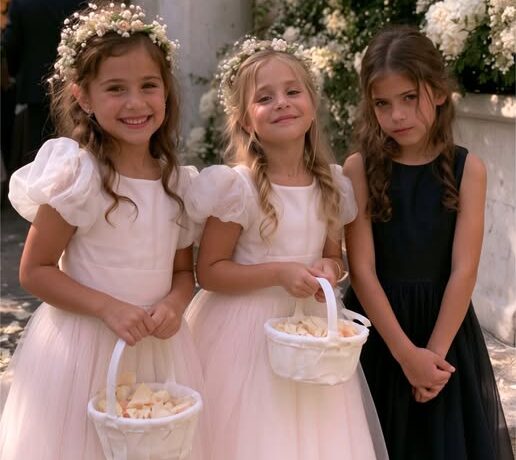
I thought the worst part of that day would be watching my daughter realize she’d been left out. I was wrong. The worst part was finding out who had made sure she stayed that way.
Part One: The Pink Shoes
My sister-in-law Jenna’s wedding was a month away, and our whole house was buzzing about it.
Mostly because of Sophie.
Our daughter was eight, and Jenna had asked her to be a flower girl back in the spring. Sophie had treated it like the most important job anyone had ever been given. The dress was already hanging in her closet, pale pink with a satin sash, zipped into a garment bag she checked on every few days like it might wander off. She had picked out her own shoes, soft pink flats with tiny bows on the toes, and she wore them around the house in the evenings “to break them in,” even though I told her twice that flats don’t really need breaking in.
She practiced in our hallway. Every night after dinner, she would take the little wicker basket I’d found at a craft store, fill it with torn-up tissue paper, and walk from the front door to the bathroom as slowly as she possibly could, scattering paper petals with great seriousness.
“Is this too fast?” she’d call out.
“It’s perfect, honey.”
“Am I supposed to smile while I throw them, or just smile at the end?”
She must have asked me that question ten times. I told her she could smile the whole way if she wanted. She thought about it and decided she would smile the whole way but “not like a crazy person.”
“I want to be perfect,” she told me one night, crouched in the hallway picking tissue paper out of the rug.
“You will be.”
Then Jenna called.
I was standing in the kitchen, halfway through unloading the dishwasher, when I saw her name on my phone. I answered thinking she wanted to talk about hair appointments or the rehearsal dinner.
“Hey,” she said. Her voice was flat. “I wanted to let you know we’re making some changes. Sophie’s not going to be a flower girl anymore.”
I set down the plate I was holding.
“What?”
“We decided to keep the ceremony simple.”
I remember looking toward the hallway, toward Sophie’s bedroom, toward the pink dress in its garment bag.
“But you already asked her,” I said. “Jenna, she’s been practicing for weeks. She’s so excited.”
She sighed. “I’m sorry. We changed some things.”
“What things?”
“Just… things. It’s simpler this way.”
That was all she would give me. A few minutes later, the call ended, and I was left standing by the open dishwasher trying to figure out how to tell my daughter.
Part Two: “Did I Do Something?”
I told Sophie that evening, sitting on the edge of her bed.
I tried to make it sound small. A change in plans. Grown-up wedding stuff. Nothing anyone could help.
Her face fell before I’d even finished the sentence.
“But Aunt Jenna said I could do it.”
“I know, honey.”
“Did I do something?”
“No. You didn’t do anything.”
“Then why?”
“They changed the wedding plans. They decided to make it simpler.”
She looked down at the floor, where her pink shoes were lined up neatly beside the bed. She didn’t cry. She just looked at them for a long time.
“Can I still wear these?” she asked quietly.
“Of course you can.”
She nodded and didn’t say anything else. Later that night, I passed her room and saw that the wicker basket had been moved from her dresser to the back of her closet, behind the garment bag, where she wouldn’t have to look at it.
That small thing hurt more than anything she’d said.
My husband, Marcus, was much calmer about it than I was.
“It’s Jenna’s wedding,” he said when I told him that night. He was sitting on the couch with his laptop, barely looking up. “She can make whatever changes she wants.”
“She shouldn’t have asked Sophie in the first place if she wasn’t sure.”
“I agree.”
“Then why aren’t you angry?”
He shrugged. “What do you want me to do? Call her and fight about it?”
“I want you to act like it bothers you.”
“It does.”
It didn’t look like it did. It looked like he wanted the conversation to be over.
But then, Marcus and Jenna had been strange with each other for weeks. I’d noticed it without really thinking about it. Short phone calls that ended with Marcus pacing out to the garage. No more jokes in the family group chat, where the two of them used to tease each other constantly. Jenna hadn’t come over for dinner in almost two months, and she used to drop by every other Sunday.
Every time I asked, Marcus gave me the same answer.
“She’s just busy.”
I assumed it was wedding stress. Planning a wedding makes everyone a little crazy, and Jenna had always been intense when she was under pressure. So I let it go.
Mostly I let it go because Sophie eventually stopped talking about it. The questions faded. The hallway practice stopped. She still wore the pink shoes around the house sometimes, but she didn’t mention the wedding at all.
I told myself that meant she was okay.
Part Three: The Little Girls in Pink
The wedding was held at a garden venue just outside of town.
It was beautiful. I’ll give Jenna that. Everything was soft blush and cream and pale green, and the colors blended together so naturally it looked like the garden had grown that way on its own. There were flowers everywhere, climbing the arbor, lining the aisle, spilling out of stone urns along the paths.
Sophie wore her pink shoes. She’d insisted.
We checked in at the little table by the entrance, and the very first thing I saw as we walked through the gate was a little girl in a pale pink dress, carrying a basket of petals.
I stopped.
I tried to tell myself it didn’t mean anything. Maybe she was a guest’s daughter who’d dressed up. Maybe the basket was just for fun.
Then a second little girl walked past us. Same dress. Same basket.
I turned to Marcus. “I thought there weren’t going to be any flower girls.”
He acted like he hadn’t heard me. He was looking at his phone, or pretending to.
A few minutes later, I saw two little boys in matching suspenders and bow ties, each carefully holding a small velvet ring box. Another child, one of Marcus’s cousin’s kids, was standing near the entrance handing out programs with enormous pride.
I looked around the garden, and the picture slowly came together.
Every child in the immediate family had a role.
Every child except Sophie.
She noticed too. Of course she did. Kids always notice.
We’d found our seats, and she was sitting very straight in her chair, her hands folded in her lap, watching the two flower girls giggle together by the arbor. Then she leaned toward me.
“Mom?” she whispered.
“Yeah, sweetheart?”
“Why did Aunt Jenna lie?”
I didn’t have an answer.
I looked at her face. She wasn’t crying, and somehow that made it worse. She looked embarrassed. Like she’d finally understood that the story we’d told her about “keeping things simple” had never been true, and she was ashamed for having believed it.
She was eight years old, sitting in her best dress and her pink shoes, quietly working out that she’d been singled out.
Something in me snapped. I stood up.
Marcus grabbed my arm.
“Where are you going?”
“To talk to your sister.”
“Not now.”
“Our daughter is the only child here who got removed.”
“I can see that.”
“Then why aren’t you angry?”
He looked away.
And in that small movement, I saw it.
“You knew,” I said.
He didn’t answer.
“You knew there were still flower girls.”
“Please,” he said quietly. “Let it go.”
“I can’t. I need to know why.”
“Not here.”
Something cold settled in my chest. I pulled my arm out of his hand and walked straight toward Jenna.
Part Four: “Because Your Husband Asked Me To”
Jenna was near the side of the venue, posing for photos with the two flower girls. She was laughing, holding her bouquet, looking every bit the happy bride.
Then she saw my face, and her smile disappeared.
“Can we talk?” I said.
She handed her bouquet to one of her bridesmaids. “Sure.”
I pointed toward the girls in pink. “You told me there wouldn’t be flower girls.”
Jenna’s eyes went past me, toward Marcus.
That made me angrier than anything. “I’m talking to you.”
She took a breath. “I didn’t take Sophie out because I don’t want her here.”
“Then why did you?”
She hesitated. Then she said, “Because your husband asked me to.”
“What?”
Marcus was already walking toward us, fast. “Jenna. This is not the time.”
She ignored him. “I’ll be honest. I was angry when I first took Sophie out.”
“So you did take her out. Angry about what?”
“About something between Marcus and me.”
I looked at him. He said, “We are not discussing this now.”
Jenna let out one short, humorless laugh. “Of course we’re not.”
I turned back to her. “So you punished my daughter because you were angry at her father.”
Her face tightened. But she didn’t deny it.
“At first. Yes. I changed my mind later.”
At least she didn’t lie about it.
“It was wrong,” she added.
“You think?”
She actually looked ashamed. “I called Marcus three days later and told him I wanted to put Sophie back in.”
“Then what happened?”
Jenna pointed at her brother. “He told me not to.”
I turned to Marcus slowly. “You could have fixed this?”
He rubbed both hands over his face. “It wasn’t that simple.”
“It sounds very simple.”
“It wasn’t.”
“She offered to put Sophie back in, and you said no.”
“That’s not really what happened.”
“Then what happened? Why?“
Jenna crossed her arms. “Tell her.”
Marcus shot her a look. “That’s enough, Jenna.”
“No. You wanted all of this kept quiet. Look how well that worked out.”
“What are you two talking about?” I said.
Jenna looked at me. “Marcus borrowed money from me.”
“What money?”
“We’ll talk at home,” Marcus said.
“No. I need answers now. How much?”
“Six thousand dollars,” Jenna said.
I actually laughed. The number sounded so ridiculous that my body didn’t know what else to do with it.
“Six thousand dollars? For what?”
Jenna didn’t answer. Marcus did.
“It was an emergency.”
“What emergency?”
“I’ll tell you later.”
I glanced around. Guests were starting to notice us. The ceremony hadn’t started yet, but people were drifting toward the seats, and more than a few heads had turned our way. I lowered my voice.
“What emergency required you to borrow six thousand dollars from your sister without telling me?”
He said nothing.
That’s when I noticed Ryan.
Part Five: The Brother Who Couldn’t Look at Me
Ryan was Marcus’s younger brother. He was standing about ten feet away, near a row of rose bushes, staring at the three of us.
When I looked directly at him, he looked away immediately.
The sick feeling in my stomach came back, heavier this time.
“Ryan knows?”
“Leave Ryan out of this,” Marcus said.
“So he does know.”
Ryan looked miserable. He shoved his hands in his pockets and stared at the grass.
“Everyone knows,” Jenna said, “except you.”
That landed like a slap.
Marcus’s head snapped toward her. “That’s not fair.”
“Isn’t it?”
He turned and walked away from us, toward the parking lot.
I started after him, but Ryan stepped into my path.
“Please,” he said. “Can we talk about this later?”
I glared at him. “Get out of my way.”
“It’s not what you think.”
“Then tell me what’s going on.”
“The money wasn’t for Marcus.”
“What?”
Ryan glanced toward his brother’s retreating back. Then he looked at me.
“It was for me.”
I didn’t understand. Ryan had a good job. At least, I’d always thought it paid well. He and his wife, Dana, had just redone their kitchen. He drove a newer car than we did.
He rubbed the back of his neck. “I got into some trouble.”
“What kind of trouble?”
He closed his eyes for a second. “Gambling. I lost money gambling.”
I didn’t even know he gambled.
“It started online,” he said. “Sports betting. Just for fun at first. Then cards. Then I started trying to win back what I’d lost, and it got… worse.”
I felt sick. “How much?”
“More than six thousand.”
“How much more?”
He swallowed. “Almost twenty thousand.”
I just stared at him. He looked like he wanted the ground to open up and take him.
“I went through my savings first,” he said. “Then I started using credit cards.”
“Does Dana know?”
He shook his head. “Not yet. I haven’t told her.”
I hadn’t known that either. Apparently I knew very little about anything.
“I panicked,” Ryan went on. “I called Marcus. He didn’t have enough to cover it.”
“So he borrowed it from Jenna.”
“Yes.”
“Why didn’t he tell me?”
“Because I begged him not to. I was scared it would get back to Dana.”
I laughed again, and this time it was bitter.
“So everyone gets to beg my husband to keep secrets from me, and he just agrees?”
Ryan flinched. “I was ashamed.”
“I don’t care.”
“I’m sorry.”
“Being ashamed doesn’t make it okay for Marcus to borrow six thousand dollars behind my back.”
He nodded. “You’re right.”
Part Six: How It All Fit Together
I made myself breathe. Then I made him tell me the rest.
“When was this?”
“About five months ago.”
“And Jenna thought Marcus needed the money for himself?”
“Yes.”
“So he lied to her too.”
“Yes.”
“What did he tell her?”
“That there was an emergency expense at home.”
“So she thought the money was for us.” I pressed my hand to my forehead. “And I never knew a thing.”
“I told Marcus I’d pay him back before Jenna’s wedding,” Ryan said.
“Why before the wedding?”
“Because he’d promised Jenna he’d have it back to her by then.”
“But you didn’t pay him back.”
His face tightened. “I couldn’t.”
“Because you’re still gambling?”
“No. I stopped. I swear I stopped. But I owed more than I’d admitted to him. A lot more.”
“So you lied to Marcus too.”
“Yes.”
And there it was. Not an excuse for what Jenna had done to Sophie. But an explanation for her anger.
“How did Jenna find out?” I asked.
“She asked me why Marcus was so late paying her back. I thought she already knew the whole story, so I told her the money had been for me. To get me through a bad situation.”
“When was that?”
“About two months ago.”
Two months. Exactly when Jenna stopped coming over. Exactly when the group chat went quiet and the phone calls started ending in the garage.
Ryan nodded toward the arbor. “They had a huge fight.”
I already knew where this was going.
“And then she took Sophie out of the wedding.”
He looked ashamed. “Yes.”
“To punish Marcus.”
He nodded.
“And then she changed her mind.”
He didn’t say anything.
I crossed my arms. “Tell me the rest, Ryan.”
He hesitated for a long moment. “Marcus told her there was no need to put Sophie back in.”
“Why?”
“He thought if Sophie stayed in the wedding, there’d be more family stuff. Rehearsals. Fittings. The dinner. You’d be spending a lot more time around Jenna.”
For a second, I couldn’t speak. Every piece clicked into place at once.
“He thought I’d find out,” I said. “If I spent time with her, I’d find out about the loan.”
Ryan nodded.
So that was it. That was the reason.
My daughter hadn’t lost her place in the wedding because of a simpler ceremony. She hadn’t even lost it, in the end, because of Jenna’s temper.
She’d lost it because her father was protecting himself.
Part Seven: In the Parking Lot
I found Marcus near the edge of the parking lot, standing beside our car with his hands on the roof.
“What you did was really selfish,” I said.
He turned around. One look at my face, and he knew.
“Ryan told you.”
“Yes. Ryan told me. I should have heard all of this from you.”
He closed his eyes. “You’re right.”
“Jenna offered to put Sophie back in, and you said no. You hurt your own daughter.”
“I know. And I’m sorry.”
“You said no to the thing that made her happiest because you were afraid I’d find out about a loan.”
He didn’t answer.
“Say it, Marcus.”
He let out a long breath. “Okay. Yes.”
My eyes filled.
“She spent a whole month thinking her aunt changed her mind about her.”
He looked at me helplessly. “I thought she’d get over it.”
“She’s eight. That meant the world to her.”
“It was one wedding role. She’ll have others.”
“It wasn’t one wedding role.”
I pointed back toward the garden.
“She asked me today why her aunt lied to her. She sat there and watched every other kid in this family get included, and she figured out that she was the only one who wasn’t. She thinks something is wrong with her.”
Something changed in his face. “I didn’t think of it like that.”
“Exactly. You didn’t think about her at all. You were only thinking about yourself.”
I was crying now, and I didn’t care who saw.
“You thought about whether I might ask you uncomfortable questions.”
“I was trying to help Ryan.”
“I’m not angry that you helped Ryan.”
He blinked at me.
“I probably would have helped him too,” I said. “I’m angry that you didn’t ask me. You lied. You hid things. And then when our daughter got caught in the middle of it, you decided her feelings mattered less than your secret.”
“I messed up,” he said quietly. “I’m so sorry.”
“You should be.”
I turned around and walked back inside.
Sophie was sitting with my mother-in-law near the end of a row, swinging her feet. I knelt down in front of her.
“Hey, sweetheart.”
She looked at me carefully. “Am I in trouble?”
My heart cracked straight down the middle. “No. Absolutely not.”
“Then why is everyone mad?”
“Because some grown-ups made some bad choices.”
I glanced toward Jenna, who was standing by the arbor with her face blotchy, trying to pull herself together before the ceremony.
“Your aunt was angry about something that had nothing to do with you.”
Sophie frowned. “Is that why she took me out?”
I didn’t know how to answer honestly without dumping adult problems onto a child. So I said, “Sometimes grown-ups make unfair decisions when they’re angry.”
She looked down at her pink shoes. “I don’t want to be a flower girl now.”
I nodded. “You don’t have to be.”
Part Eight: What an Eight-Year-Old Paid For
We stayed for the ceremony. It felt important not to run.
Afterward, while guests were moving toward the reception tent, Jenna came over and crouched down in front of Sophie in her wedding dress, right there on the grass.
“Can I talk to you?”
Sophie shrugged.
Jenna took a deep breath. “I owe you an apology.”
Sophie just looked at her.
“I was angry at your dad, and I made a decision that hurt you. You didn’t do anything wrong.”
“Then why me?”
Jenna’s eyes filled. “Because I was angry, and I wanted your dad to feel bad too.”
Even I appreciated that she didn’t sugarcoat it.
Sophie frowned. “That’s mean.”
Jenna nodded. “Yes. It was.”
“You made me think you didn’t like me.”
Jenna started crying for real then. “I know. I’m so sorry.”
Sophie looked at me. I didn’t tell her to forgive her aunt. That wasn’t my job. Forgiveness forced out of a child isn’t really forgiveness anyway.
Finally, Sophie said, “Okay.”
We left before the reception ended. I was exhausted, and I needed room to think. Marcus came with us, but we barely spoke during the drive home.
The real conversation happened the next day.
He showed me everything. The messages with Jenna about the loan. The bank transfer. Ryan’s debts. The repayment plan that had never actually happened.
When he was done, I asked, “Is there anything else?”
“No.”
“Think carefully.”
He did. Then he said, “No.”
I believed him. But believing him and trusting him again were two very different things, and I wasn’t ready for the second one.
Ryan came over that evening. He didn’t ask for money. He told us he’d started going to a gambling recovery group and had self-excluded from every betting platform he’d been using. He was seeing a counselor, and he’d worked out a real repayment plan with Jenna. He said he was going to tell Dana that week.
“I need to fix what I did,” he said.
“I’ll still help you,” Marcus told him.
Ryan shook his head. “Not like before. You can’t keep lying for me. If staying clean means everyone around me has to hide things, then I’m not actually fixing anything.”
That surprised me. I respected him for it.
Two days later, Marcus sat down beside Sophie on the couch to apologize. He didn’t blame Jenna.
“Aunt Jenna made a bad decision when she was angry,” he said. “Then she tried to fix it.”
Sophie looked up at him. “Then what happened?”
He swallowed hard. “I said no.”
“Why?”
“Because I was hiding a grown-up problem, and I was scared Mom would find out.”
Sophie looked confused. “So you didn’t want me to be a flower girl?”
Marcus’s face crumpled. “I did want you to be. So much.”
“Then why did you say no?”
“Because I made a selfish choice.”
Sophie considered this very seriously. “Yes. It was.”
Marcus laughed through his tears. “Very.”
Things aren’t magically fixed. Ryan is still paying off his debt. Jenna and Marcus are talking again, but carefully, like people walking on ice that hasn’t fully frozen.
I told Marcus there will never be another secret loan. Not for Ryan, not for anyone. If either of us ever wants to lend or borrow thousands of dollars, we talk about it first. He agreed without arguing.
The bigger rule was harder to say out loud, but I said it anyway.
Our daughter never becomes collateral damage in adult secrets. Ever.
What This Story Taught Me
I thought the worst part of that day was seeing those two little girls in pink dresses walk past us with their baskets.
It wasn’t. The worst part was realizing Sophie had spent a whole month confused and hurt because of choices the adults around her made.
Ryan had a gambling problem. Marcus kept secrets. Jenna let her anger land on the wrong person. And somehow, an eight-year-old girl in pink shoes ended up paying for all three.
I understand why Marcus wanted to protect his brother. I even understand why Ryan was ashamed. What I’m still working on forgiving is the moment Marcus had a chance to tell the truth and decided our daughter’s heartbreak was easier than my questions.
Helping someone you love doesn’t mean hiding everything they do. And protecting a family doesn’t mean keeping the peace at any cost.
Sometimes it means telling the truth before the youngest person in the room ends up carrying the consequences.