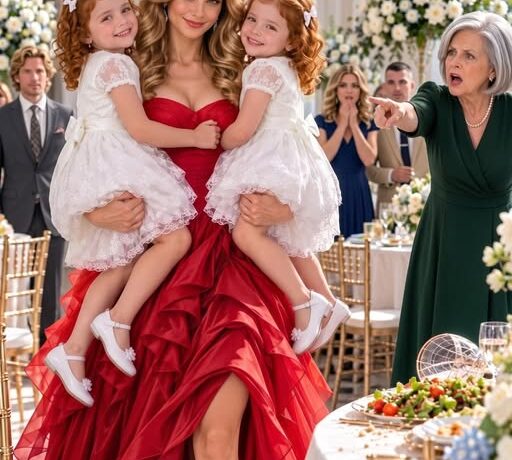
They thought I was the wife with the little real-estate hobby. They thought my daughters counted for less because they were girls. They thought the mansion belonged to him. They were wrong about all three, and it took one stolen plate of chicken for me to stop letting them believe it.
Part 1
My mother-in-law didn’t just take the plates away from my daughters.
She made sure people saw her do it.
Of everything that happened that afternoon, that is the part I still think about. Not the plates themselves. Not the food. The audience. The way she paused just long enough, with her back straight and her chin lifted, so that the guests at the neighboring tables would turn their heads and understand exactly what was happening and exactly who it was happening to.
My husband, Dalton Whitmore, had invited close to eighty people to what he kept calling his “new-home celebration.” The house sat on several acres outside Great Falls, Virginia, the kind of property you see photographed in glossy magazines at the dentist’s office and never imagine anyone actually living in. A long driveway of pale stone wound between clipped boxwood hedges and old oak trees. Behind the house, white tents had been staked across the back lawn. A jazz trio played near the terrace, all soft brushes on the snare and lazy saxophone. Servers in black vests moved between the tables with trays of crab cakes, beef tenderloin, lemon chicken, and little glasses of something sparkling.
For weeks, Dalton had been telling anyone who would listen that this house was the start of his next chapter.
His cousins hugged him and called him “the big shot.” His coworkers clapped him on the back. His older brother, Wade, walked the property line with a beer in his hand like a man inspecting land he was thinking of buying.
And his mother, Lorraine Whitmore, floated across the lawn in a cream silk blouse as if the entire afternoon were proof of something she’d been saying for thirty years. That her son was special. That he was going places. That she had raised a man worth bragging about.
There was only one problem.
Dalton didn’t own the house.
But nobody knew that yet. Not his mother. Not his brother. Not the eighty people eating his tenderloin.
Only me.
My daughters were sitting beside me at a round table near the edge of the terrace. Ivy was nine, all elbows and careful manners. Rosie was six, with a gap where her front tooth used to be and a pale yellow dress she had picked out herself because she said it looked “like lemonade.”
Ivy was still working on her lemon chicken, cutting it into small, neat pieces the way I’d taught her. Rosie had barely started on her potatoes. She was too busy watching the saxophone player, swinging her feet under the table.
I didn’t see Lorraine coming until she was already there.
She didn’t say hello. She didn’t say anything at all. She simply reached down, lifted Ivy’s plate off the table, and held it against her hip.
Ivy froze with her fork in the air.
Then Lorraine reached for Rosie’s plate.
Rosie, who has never once in her life let something go without a question, put her small hand flat on the tablecloth right beside it.
“Grandma, I’m not done yet.”
Lorraine smiled. It was a thin, tidy smile, the kind people wear in church when someone sits in their usual pew.
“There’s plenty of simpler food for you, sweetheart. This menu was really planned for the family table.”
I stared at her. For a moment I honestly thought I had misheard.
Then she turned and looked straight at me.
“Some traditions still matter, Meredith. A family has to think about who’s going to carry the name forward.”
And there it was.
The same message she had been tucking into birthday cards, holiday dinners, and offhand comments for years. Sometimes it came as a joke. Sometimes as a sigh. Once, at Christmas, it came as a question she asked Dalton right in front of me: “Are you two going to try again for a boy, or have you given up?”
My daughters were girls.
And in Lorraine’s mind, that made them a little less Whitmore than they should have been.
She set a plastic takeout container down in front of us. Through the foggy lid I could see what was inside: a heel of bread, a few limp green beans, some scraps of roasted vegetables, the kind of leftovers you scrape off a serving tray at the end of a buffet.
“This should be more than enough for them,” she said.
She pushed it across the table harder than she needed to. The lid popped up at one corner, and a spray of sauce flew out. A dark streak landed on the front of Rosie’s lemonade dress. A single drop hit Ivy just beside her cheek.
Neither of my girls moved.
That’s what I remember. Not tears. Not a fuss. Just two children going perfectly, completely still, the way small animals do when they’ve learned that stillness is safer than noise.
Then Ivy turned her head and looked across the lawn.
Toward her father.
I followed her eyes.
Dalton was sitting at the biggest table under the main tent, the one with the white hydrangeas spilling out of a silver bowl in the middle. Wade was there. Two men from Dalton’s firm were there, the ones he’d been trying to impress for most of the year. His uncle. His uncle’s new wife.
Dalton was laughing at something someone had said. But his eyes were on us.
He had seen it. All of it. The plates, the container, the sauce on his daughter’s face.
For one hopeful second, I thought he would stand up. I actually watched his shoulders shift, and some foolish part of me, the part that had been waiting twelve years for him to choose us, leaned forward a little in my chair.
He didn’t stand.
Instead, he lifted his wine glass in our direction and called across the terrace, loud enough for three tables to hear.
“Meredith, come on. Don’t turn this into a whole thing. Mom’s just being Mom. Can I please have one afternoon without drama?”
A few people laughed. Not unkindly, exactly. The way people laugh when they want a moment to be over.
And something inside me went quiet.
It wasn’t rage. I had expected rage, if this moment ever came. I had pictured it many times, late at night, the moment I’d finally had enough. In my imagination I always stood up and said something sharp and devastating that people would repeat in the car on the way home.
But that isn’t what happened.
What happened was a kind of stillness. A door closing somewhere very deep inside me, soft and final, like a hand settling on a latch.
I wasn’t shocked.
I was finished.
I took the cloth napkin from my lap, dipped the corner in my water glass, and gently wiped the sauce from Ivy’s cheek. Then I turned to Rosie and dabbed at the stain on her dress. It didn’t come out. It was only going to spread.
Neither of my daughters said a word. Rosie kept glancing at the takeout container like it might do something else.
And as I looked at them, I understood something that made my chest ache.
All those years of keeping the peace, of smiling through Lorraine’s comments, of telling myself it wasn’t worth the argument, of letting Dalton’s “don’t start” end every conversation before it began, I had believed I was protecting them.
I wasn’t.
My silence had been teaching them a lesson I never meant to teach. It had been telling them, every single time, that keeping everyone comfortable mattered more than standing up for their dignity.
They had learned it well.
That’s why they weren’t crying.