At eighteen, I wore his ring. A month before our wedding, he sent me four cold sentences and disappeared from my life. I built a whole, good life without him. Then, at seventy-three, his voice came back on the phone with the strangest request a dying man could make. I said yes without knowing why. The answer was waiting in a bank vault.
Part 1
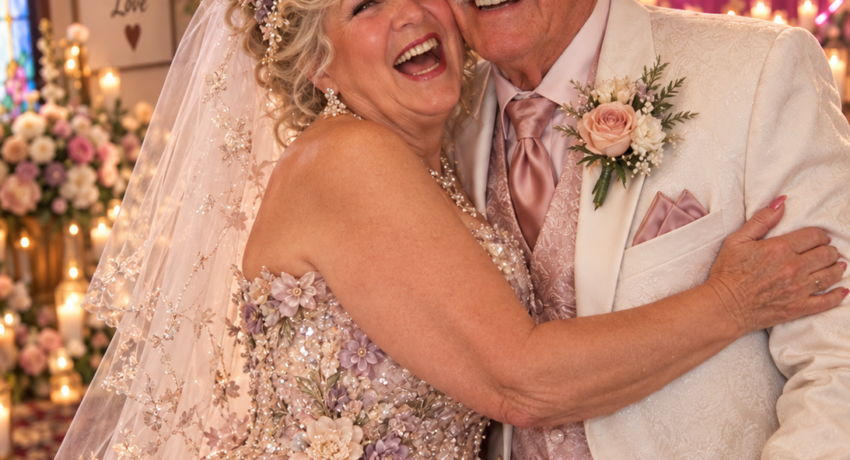
My children were sure I was being manipulated when I agreed to marry the man who had abandoned me fifty-five years earlier. His family was sure I wanted his money.
They were both wrong. The truth was locked behind a small brass key, and I wouldn’t hold it in my hand until after we buried him.
It started with a phone call on an ordinary Tuesday afternoon.
I answered the way I always do, a little distracted, a cup of tea cooling beside me. There was a pause on the line. A soft, labored breath. And then a voice said my name.
“Eleanor.”
Decades had passed, but I knew that voice the way you know a song from your childhood. My knees went weak, and I sat down at the kitchen table so fast that tea sloshed into the saucer.
“Thomas?”
His laugh was thin and brief. “So you remember me.”
My eyes went to the framed photograph on the shelf. My late husband, George, smiling at me the way he always had.
He’d been gone four years by then. We’d had forty-six good years together. Three children. Five grandchildren. Arguments about money, vacations that went sideways, illnesses, birthdays, and a life I would never, ever call second best.
But before George, there had been Thomas.
At eighteen, I was certain Thomas and I would grow old together.
We’d chosen names for children we never had. We’d walked through neighborhoods on summer evenings and picked out the house we’d buy someday, the one with the porch swing and the crooked mailbox. Under the big oak tree behind my parents’ church, he’d slipped a thin gold ring onto my finger and asked me to be his wife.
One month before the wedding, a letter came.
It was four sentences long.
Eleanor,
I have made my choice. I cannot marry you. Do not wait for me, and do not try to contact me.
Thomas.
That was all. No explanation. No goodbye. Within a few weeks, he’d moved away, and the town swallowed the gossip whole.
My wedding dress was already hanging in my mother’s closet. The invitations had gone out. I remember standing in the church office, my face burning, as my father quietly asked the pastor to cancel the date. I remember the women at the grocery store who suddenly lowered their voices when I passed by.
I took off the thin gold ring and put it in a tin box at the back of my dresser drawer. I couldn’t bring myself to throw it away. I couldn’t bring myself to look at it either.
For years, I tormented myself looking for the warning I must have missed. I replayed every conversation, every kiss, every promise we’d made under that oak tree. Was there another girl? Had he simply looked at me one day and realized I wasn’t enough?
Eventually, I stopped asking.
George came along three years later, a patient, broad-shouldered man who fixed my car for free and then kept finding excuses to check on it. He never asked me to forget anything. He just made it easier to stop looking backward.
I married George. I raised our family. I became a schoolteacher, then a grandmother, then a widow. Thomas became a sealed room in the house of my memory, one I’d stopped trying to open.
Until that phone call.
The silence stretched so long I thought the line had dropped.
“I’m dying,” he said.
I closed my eyes. “I’m sorry.”
“Pancreatic cancer. The doctors say weeks, not months.”
My hand tightened on the receiver. “Why are you calling me?”
“Because I need to ask you one last favor.”
He asked if I would come see him the next afternoon.
My daughter, Rachel, thought I’d lost my mind.
“He abandoned you, Mom,” she said. “And now he’s dying, so he calls and expects you to come running?”
“He isn’t asking me to run.”
“You don’t know what he’s asking.”
She was right. Neither did I.
I went anyway.
Thomas lived two hours away in a private care residence. I drove there alone, gripping the steering wheel the whole way, rehearsing all the things I’d wanted to say to him for half a century. By the time I pulled into the parking lot, I couldn’t remember a single one.
The building was elegant and hushed, with polished floors and fresh flowers at the front desk. Money, I thought. Thomas had clearly done well for himself.
When the nurse showed me into his room, an old man was sitting by the window, and for one awful second, I saw nothing of the boy I’d loved.
Then he turned his head and looked at me.
The eyes were the same.
“Eleanor.”
I stayed by the door.
“You look well,” he said.
“You look terrible.”
He laughed, and it turned into a cough. “Still honest.”
He was painfully thin, his skin gray, his hands trembling on the arms of the chair. An oxygen tube ran beneath his nose. And on the little table beside him sat a photograph of me at eighteen, smiling in a summer dress.
I couldn’t stop staring at it. “Why do you have that?”
“I kept more than I should have.”
He gestured toward the chair across from him. I sat, but I didn’t take off my coat.
“What’s the favor, Thomas?”
He looked out the window for a long time, as if the words were somewhere out on the lawn and he had to go find them.
Then he turned back to me.
“Marry me.”