Eight dollars and forty-two cents. That’s all it was. A small kindness at the end of a long shift, the kind you forget by the time you get to your car. I had no idea it would pull me straight into my mother’s past, or toward a secret someone had spent forty years and a small fortune keeping hidden in plain sight.
Part 1: The Envelope on Gary’s Desk
There was a photograph of me in that envelope that I had never seen before.
I was about five. Pigtails, scabbed knees, a striped T-shirt with a popsicle stain down the front. I was standing in our backyard beside my mother, squinting into the sun, holding her hand with both of mine like I was afraid she’d float away.
I knew that yard. I knew that fence, the crooked one Mom never got around to fixing. I knew the lilac bush behind us, because I still mowed around it every Saturday.
What I didn’t know was who had been standing on the other side of the camera.
Because my mother never owned a camera. And in forty years, I had never once seen this picture.
My manager, Gary, was watching me from behind his desk. “Molly? You okay?”
I didn’t answer. I couldn’t. I was holding the most ordinary moment of my childhood, and it felt like a stranger had reached into my house and pulled it out of a drawer.
To understand why that photograph knocked the air out of me, you need to know who I was the day before. And you need to know about the eight dollars.
At forty, I had gotten very good at living a life that asked almost nothing of me.
I lived alone in the small blue house where my mother raised me. I worked the register at Halvorsen’s Market, the same grocery store where she’d worked the deli counter for eleven years before her knees gave out. I drove the same route every morning, parked in the same spot under the same sickly maple, and ate the same turkey sandwich on my break.
It wasn’t a sad life, exactly. It was a quiet one. And after everything, quiet had started to feel like safety.
Tasha worked the register next to mine. She was ten years younger, loud in all the best ways, and somewhere along the line she’d become my closest friend and the nearest thing to family I had left after Mom died.
That Friday, she watched me hand Mr. Pruitt his lottery ticket before he even reached the counter. Quick Pick, two dollars, same as every Friday since the Obama administration.
“Six years,” Tasha said, shaking her head. “Six years here and you know everybody’s routine.”
“Pretty much.”
“Doesn’t that drive you crazy?”
“What?”
“Knowing exactly what tomorrow’s going to look like.”
I shrugged and scanned a bag of frozen peas. “There are worse things than predictable.”
That wasn’t entirely true. And I think she knew it.
Because there had been a time when I wanted more. Much more.
Once, during a slow Tuesday, I’d told her about the bakery.
“My mother used to own that bakery downtown,” I said. “On Main, across from the old bank.”
Tasha squinted. “The empty one? With the green awning?”
“That’s the one. Her father opened it. She inherited it when he died.”
“What happened?”
“Money got tight after I was born. She sold it and bought our house with what was left.”
“That must’ve been hard for her.”
“It was.” I straightened a stack of plastic bags that didn’t need straightening. “And here’s the strange part. Nobody ever bought it after that. Thirty-some years, and it’s just been sitting there.”
“Maybe nobody wants it.”
“Everything else on that block has changed hands three times. The hardware store’s a yoga studio now. The shoe repair is a vape shop. But that bakery? Same dusty windows. Same faded awning.”
Tasha leaned on her register. “Then maybe you should buy it.”
I laughed. “I used to think I would. When I was a kid, I swore I’d buy it back for her someday.”
“What stopped you?”
“My bank account.”
“You could still do something, you know. Someday.”
“Tasha, I’m forty.”
“So?”
“So I think ‘someday’ has officially turned into ‘probably not.’”
The second the words left my mouth, I remembered a conversation with Mom from years ago. We were sitting on the back steps, shelling peas into a colander, and I asked her the question I’d been carrying since I was old enough to understand what she’d given up.
“Did you love it? The bakery?”
She smiled, but it was the sad kind. “Very much.”
“Then why did you sell it?”
She didn’t even hesitate.
“Because I loved you more.”
I never met my father.
Mom told me the truth when I was ten, sitting on the edge of my bed after I came home crying because a girl at school said I didn’t have a dad because nobody wanted me.
“He was married when we met,” Mom said quietly. “I didn’t know at first. By the time I did, I was already in love with him. And when I found out I was pregnant, he chose his wife.”
“So he knew about me?”
“Yes.”
“And he still left?”
She looked down at her hands. “He did.”
I asked a few more times as I got older. What was his name? What did he look like? Did he ever ask about me? Each time, her face would close like a door, and eventually I stopped knocking.
Years went by. I got married at twenty-six to a man who was kind until he wasn’t, and divorced at thirty-three. I took back my mother’s last name. And when she died four years ago, after a stroke on an ordinary Wednesday morning, I found myself rattling around the same house she’d raised me in, with the same lilac bush, the same crooked fence, and nobody left to ask.
“You ever think about leaving?” Tasha asked me once.
“The house?”
“Everything. This town. Starting over somewhere else.”
“Sure.”
“So what stopped you?”
I thought about it honestly. “Starting over just seemed exhausting.”
But that was all years ago. By that Friday, I had stopped expecting my life to change at all.
It was a quarter to eight when she got into my line.
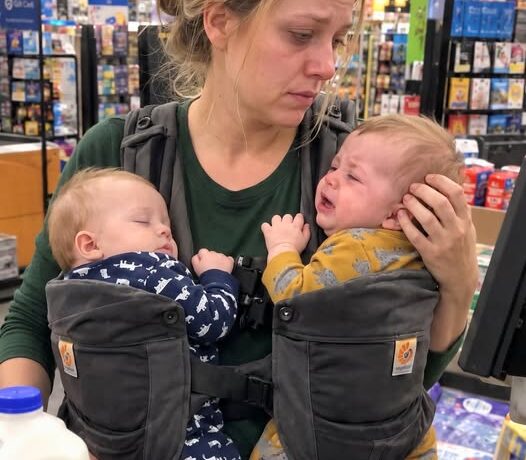
She was carrying two tiny babies. One was strapped to her chest in a carrier, asleep with his mouth open. The other was in a car seat hooked over her forearm, red-faced and screaming at a pitch that made the man behind her wince.
She looked like she hadn’t slept in a month. Her eyes were red-rimmed, her ponytail half fallen out, and there was a spit-up stain on the shoulder of her navy sweatshirt.
She set three things on the belt. A gallon of milk. A canister of formula. A box of newborn diapers.
I scanned them. “Sixty-seven eighteen.”
She tapped her card.
Declined.
“Oh.” She stared at the screen. “That’s… hold on.”
She tapped it again.
Declined.
Behind her, a man in a golf polo let out a long, loud sigh, the kind meant to be heard three aisles over.
The woman’s face flushed scarlet all the way to her ears. “I’m so sorry. Can you just take the diapers off?”
I checked the screen. “You’re only short eight forty-two.”
“I know. It’s fine. Just take them off. I’ll figure it out.”
The baby in the car seat screamed louder, as if he understood exactly what was happening.
And I looked at her face, at that particular kind of exhaustion I’d seen so many times in my own kitchen growing up, and all I could think about was my mother. Standing at a register just like this one. Counting out coins. Putting things back.
I pulled my own debit card out of my back pocket.
The woman’s eyes went wide. “What are you doing?”
“Paying the difference.”
“No. Please. You don’t have to do that.”
“It’s eight dollars.”
“Eight dollars matters,” she said, and her voice cracked right down the middle.
“I know,” I said quietly. “Believe me, I know.”
I tapped my card.
Approved.
Her eyes filled. She pressed her hand flat against the sleeping baby’s back like she needed something to hold on to. “I don’t know if I’ll be able to pay you back.”
“You don’t have to. Just take your groceries and get these boys home.”
“You have no idea what today has been like.”
“It’s okay. Really.”
She glanced at my name tag. “Molly?”
“That’s me.”
“Molly what?”
It was a strange question, but people asked strange things at the register all the time. “Kessler,” I said.
She went completely still.
Not a polite pause. Still. Like someone had pressed pause on her whole body. Even the screaming baby seemed to quiet for a second.
“Is something wrong?” I asked.
“No.”
“You look like something’s wrong.”
She blinked hard and adjusted the car seat on her arm. “I’m just tired. It’s been a long day. A long month.”
She thanked me twice more, gathered her bags, and hurried out through the automatic doors into the October dark without looking back.
I thought that was the end of it.
The next morning, Tasha caught me before I’d even clocked in.
“Gary wants you in his office.”
“Why?”
“He wouldn’t tell me. He’s being weird.”
My stomach dropped. “Am I getting fired?”
“For what?”
“I don’t know. Existing incorrectly?”
She laughed and pushed me toward the back hallway. “Go.”
Gary was sitting behind his cluttered desk with a plain white envelope in front of him. He’d managed Halvorsen’s almost as long as I’d worked there, a gentle, rumpled man in his sixties who kept a jar of butterscotch candies on his desk for anybody having a bad day.
“Sit down, Molly.”
I sat.
“Did you pay for some items last night? For a woman who came up short?”
There was no point lying. “Yes.”
“You know employees aren’t supposed to—”
“I know. I’m sorry. It won’t happen again.”
“Relax.” He held up a hand. “You’re not in trouble.”
He slid the envelope across the desk.
“She came back this morning before you got here. Asked me to make sure you got this.”
“What is it?”
“Open it.”
Inside was a five-dollar bill, three ones, a quarter, a dime, a nickel, and two pennies. Exactly eight forty-two.
And underneath the money, that photograph.
I sat back so hard the chair creaked.
“Molly?” Gary leaned forward. “Hey. You okay?”
“Where did she get this?” I barely recognized my own voice.
“Get what?”
“This picture. This is me. This is my mother. This is our backyard.”
He didn’t have an answer.
Then I saw the note, a small square of lined paper folded twice and tucked behind the photo. The handwriting was neat and careful, like someone had rewritten it several times.
I know your father. He left something for you. If you want the truth, come see me.
There was an address written underneath.
The room tilted.