A year after my sister died, I believed marrying the man who helped me raise her son would finally make our broken little family whole. I asked my nephew to carry the rings in her honor. I had no idea she’d already given him a different job, one she’d planned for exactly this moment.
Part 1: The Ring Bearer
My sister, Judy, died in a car crash on her way to pick up her son from school.
It was an ordinary Tuesday. She’d texted me at lunch about nothing, a photo of a terrible sweater she’d found at a thrift store, with three laughing emojis. Two hours later, a police officer was standing on her porch, and by nightfall I was the one picking up Bruce.
He was seven.
I didn’t get to fall apart. There wasn’t room. A little boy was sitting on my couch in his school uniform, still holding his backpack, asking when Mom was coming to take him home.
I became his legal guardian that same week.
I loved him fiercely. I also lay awake every night, convinced I was going to ruin him. I didn’t know which cereal he liked. I didn’t know he couldn’t sleep without the hallway light on. I didn’t know that when he went quiet, it meant he was about to cry and didn’t want anyone to see.
Douglas was the reason I didn’t ruin him.
We’d been together almost a year when Judy died, and he never once stepped back. He stood beside me through the funeral, one hand steady on my back. When Bruce woke up screaming from nightmares, Douglas was the one who dragged a sleeping bag into his room and slept on the floor beside his bed, night after night, until the nightmares slowed down.
He learned how to pack a lunch. He learned that Bruce liked his sandwiches cut into triangles, never rectangles, because that’s how Judy did it.
Somewhere in those long, gray months, the three of us stopped being survivors and became a family.
So when Douglas proposed six months after the funeral, it meant more to me than marriage.
It meant the home we’d pieced together out of wreckage was going to last.
There was just one thing I never got to close.
The afternoon Judy died, I’d stopped by her house on my way back from an errand. The front door was unlocked, the way it always was, and I could hear her in the kitchen, on the phone.
Her voice was sharp. I’d never heard her sound like that.
“You don’t get to decide whether she deserves to know,” she snapped.
Then she turned, saw me in the doorway, and hung up so fast she almost dropped the phone.
“Who was that?” I asked.
Her face had gone completely pale.
“I’ll explain tonight,” she said. “I promise.”
She grabbed her keys and kissed my cheek on her way out to get Bruce.
She never came home.
For a whole year, that sentence lived in the back of my mind. You don’t get to decide whether she deserves to know. Know what? And who had she been talking to? I turned it over a hundred different ways, and none of them ever led anywhere.
When Douglas and I started planning the wedding, Bruce begged to carry the rings.
“Mom would’ve wanted me to,” he said, chin up, standing very straight, very serious.
I told him of course. Then I went into the bathroom, locked the door, and cried into a hand towel. It felt like a way to bring Judy into the room on the day she should have been standing beside me. Her son, carrying our rings down the aisle.
It felt perfect.
But on the morning of the wedding, Bruce was strange.
He was quiet, which Bruce never is. He’s the kind of kid who narrates everything, every bird, every car, every random thought that crosses his mind. That morning, he barely said ten words.
He kept pressing one hand flat against the inside of his tiny suit jacket, like he was checking something was still there. When my cousin reached for the ring box to make sure it was safe, he yanked it away from her.
“I’ve got it,” he said.
My cousin raised her eyebrows at me. I just shrugged.
I figured he was nervous. Or sad. Weddings are hard when someone is missing from the front row, and the person missing from ours was his mother.
An hour before the ceremony, I found him sitting alone on a folding chair in the corner of the bridal room, the ring box resting on his knees. He was staring at it the way grown-ups stare at a phone they’re dreading to answer.
“You okay, buddy?” I asked, sitting down beside him in a cloud of tulle.
“Yeah.”
“You know you don’t have to do this if it’s too much. Douglas’s brother can carry the rings.”
His head snapped up. “No. I have to do it. Me.“
There was something fierce in his voice. Something that sounded, for a second, exactly like his mother.
“Okay,” I said softly. “It’s yours.”
So I hugged him, fixed his little bow tie, and let it go.
The ceremony was beautiful. A hundred and twenty guests. Soft music. Late-afternoon light pouring through the church windows.
Douglas was waiting at the altar, and when he saw me, his eyes filled. I remember thinking, This is it. This is the part where everything finally gets better.
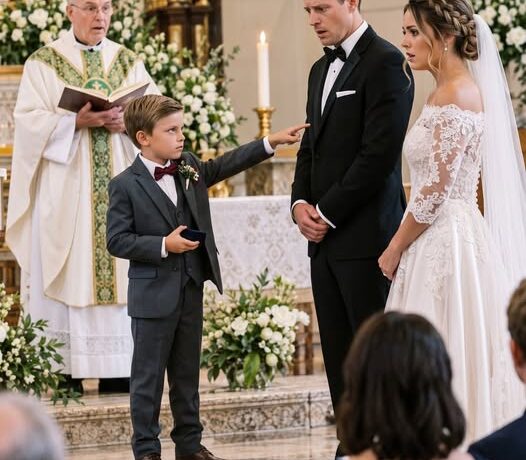
We made it through the welcome. Through the readings. Then the officiant smiled down at the small boy standing beside us in his suit.
“Bruce,” he said warmly, “may we have the rings?”
Bruce didn’t move.
A few guests chuckled softly, assuming he’d frozen up.
“Sweetheart?” I whispered.
He looked up at Douglas. Then at me.
Then he lifted his small arm and pointed straight at the man I was about to marry.
“Mom told me not to give them to him,” he said, loud and clear, “until you see this.”