
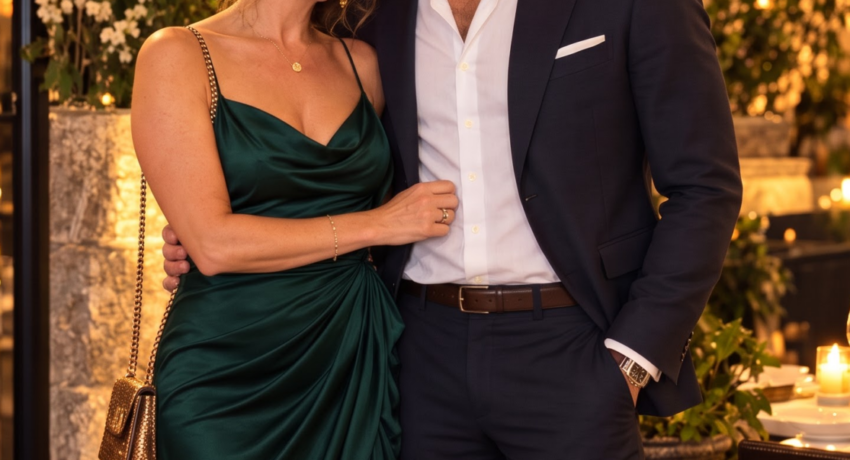
For thirty years, my husband decided what I wore, what I spent, and who I was allowed to be. When he died, I thought I was finally free. Then a kind, younger man taught me to laugh again, and I let myself believe I’d chosen him on my own. One year later, he placed a watch I’d know anywhere beside my dessert plate, and I learned that some men keep control long after they’re gone.
Part 1: The Watch I Knew by Heart
My husband, Christoph, died after a long illness. I was fifty.
People expect a widow to describe her marriage in soft colors. I can’t do that. Christoph was a jealous, controlling man, and I spent most of our thirty years together shrinking myself to fit inside his moods.
I remember one evening in particular. My company was throwing a holiday party, and for once I’d let myself make an effort. A dark green dress. Real makeup. Earrings I’d been saving. I came down the stairs feeling pretty, and Christoph looked me over from head to toe like a customs officer.
“Where are you going dressed like that?” he snapped. “Do you have a lover I don’t know about?”
I went to the party. I didn’t enjoy a single minute of it.
And yet, when he was gone, the house didn’t feel peaceful. It felt hollow. Thirty years is a long time to share a life with someone, even someone who makes that life smaller. His silence turned out to be louder than his voice had ever been.
For three years, I refused to date.
Friends tried. My hairdresser tried. A cousin tried to set me up with a retired dentist who talked about his boat for ninety minutes straight. I said no to all of it.
Part of me was still grieving, in the tangled way you grieve someone you loved and resented at the same time. The other part was simply afraid. Afraid of being alone for the rest of my life, and even more afraid of letting another man close enough to tell me who to be.
Then I met Kurt.
He worked in our operations department. He was thirty-two, friendly, quick to smile, and he seemed to show up wherever I happened to be. At first I assumed he was being polite to the boss.
He’d bring me coffee in the mornings, exactly the way I took it, though I couldn’t remember telling him. When I worked late, he’d somehow still be in the building, offering to walk me to my car. He remembered things. The name of my late mother’s village. The fact that I hated cilantro. The song I’d hummed once in the elevator.
“You don’t have to keep doing this,” I told him one evening, when he handed me yet another cup.
“I know.” He smiled. “I want to.”
What struck me most was that he never once made me feel foolish about our age difference. Not with a joke, not with a glance. If anything, he seemed to find the idea that I’d worry about it a little ridiculous.
When he finally asked me to dinner, every sensible part of me prepared to say no.
But I didn’t.
One year later, Kurt booked a table at the most expensive restaurant in town to celebrate our anniversary.
I almost didn’t recognize the woman in the window reflection as we walked in. She was wearing a red dress. She was laughing. She looked like someone who had never been asked whether she had a secret lover.
The table was perfect. Candles. A pianist playing something old and gentle in the corner. And beside my plate, a bouquet of white peonies, my favorite, which I had mentioned exactly once, months ago, in passing.
“You remembered,” I said.
“I always remember.”
We ate slowly. We talked about nothing and everything. I had a second glass of wine and didn’t count it. At one point he reached across the tablecloth and held my hand, right there, in front of everyone, and I didn’t pull away to check who was looking.
I felt happier than I had in years. Maybe in decades.
Then the dessert plates were cleared, and something in Kurt’s face changed. The warmth didn’t vanish, exactly. It drained, slowly, the way color drains from a sky.
“I need to show you something,” he said.
He reached into the inside pocket of his jacket. For one wild second, my heart jumped. A ring? At fifty-four? Was I ready for that? Did I even want it?
But it wasn’t a ring box.
He set a watch on the white tablecloth between us.
I stopped breathing.
Silver case. Navy face. A tiny scratch near the four, where it had once struck the edge of our kitchen counter. A worn spot on the leather strap where a buckle had rubbed for twenty years.
I knew every mark on that watch. I had watched it on a man’s wrist across thousands of breakfasts, and I had watched him check it, impatiently, every time I took too long to get ready.
It was Christoph’s.
My voice came out thin and strange. “Kurt… where did you get this?”
He didn’t look away. That, somehow, was the worst part. He looked straight at me, as if he’d been rehearsing this moment for a very long time.
“There’s something,” he said quietly, “that I should have told you the day we met.”