For years, I’d written off Mrs. Delaney as the neighbor who complained about everything. Then my twins came home from her porch on Halloween night with nothing in their buckets and tears streaming down their faces. What I saw on a recording I didn’t even know existed changed the way I looked at her, at my own son, and at the street I thought I could see from my front window.
Part 1: Two Empty Buckets
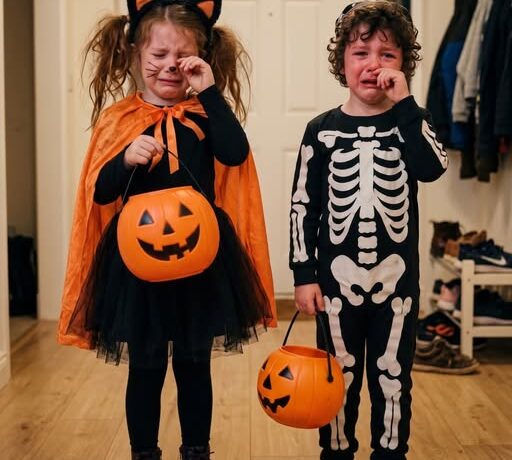
My six-year-old twins came home from trick-or-treating with two empty buckets, crying so hard they couldn’t get a single word out.
Mia and Owen had been gone for two hours.
Every Halloween, we follow the same routine. Their big brother, Cole, who’s fifteen, walks them around the neighborhood. When they reach the last few houses on our own street, he texts me and heads off to meet his friends. From there, I can watch the twins from our front window as they finish up and walk home.
Every year, I send them out with two buckets each. One for candy. One for when the first one fills up.
That night, all four came back empty.
Not “a little light.” Not “we ate some on the way.”
Empty. As if they’d never left the house.
I dropped to my knees in the entryway.
“What happened? Did someone say something to you? Are you hurt?”
Mia shook her head. Owen pressed both hands over his face.
I checked their arms, their cheeks, the seams of their costumes. Mia’s bumblebee wings were still attached. Owen’s pirate hat was crooked but intact. Nothing was torn. Nobody was bleeding.
“Sweetheart, where’s your candy?”
That only made them cry harder.
For ten long minutes, it went on like that. I rubbed their backs. I brought them water. I asked the same questions in five different ways. Every time I got close to an answer, one of them would gulp for air and the other would start sobbing all over again.
Finally, I grabbed my phone and called Cole.
He picked up on the fourth ring. Music thumped somewhere behind him, and a group of teenagers was shouting over it.
“Mom?”
“Who did you leave them with?”
“What?”
“Which house were they walking to when you left?”
There was a pause.
“Mrs. Delaney’s.”
I sat there on the floor with the phone pressed to my ear, because I genuinely didn’t know what to do with that.
Mrs. Delaney lived four houses down from us, and she was, to put it kindly, a grump. Our car was parked too close to her driveway. Our kids were too loud. Our bins went out too early on trash night. If a basketball so much as rolled onto her lawn, she’d be standing at her front window before anyone could run over to grab it.
But that was the extent of it.
In all the years we’d lived on that street, we had never once had a real argument. She’d sigh. She’d frown. She’d leave the occasional pointed note. That was all.
And my twins wouldn’t tell me she’d done anything to them.
They wouldn’t tell me anything at all.
I hung up on Cole and called my husband.
Chad was working late. The moment he answered, I said, “I’m going over there.”
“Over where?”
“Delaney’s. The kids came home hysterical, and their buckets are completely empty.”
“Jelitta, don’t.”
“Don’t what?”
“Don’t march over there angry when you don’t even know what you’re angry about yet.”
“Chad, they can’t even talk.”
He went quiet for a moment. Then he said something I didn’t expect.
“Open my laptop. We’ve got cameras.”
I pulled the phone away from my ear and stared at it.
“What cameras?”
“I put them up a few weeks ago. I didn’t want to worry you.” He exhaled. “Somebody messed with the tire on purpose.”
I remembered that morning. Chad had come back inside, jaw tight, insisting the damage on our car didn’t look like an accident. I’d told him he was being paranoid. Apparently, he hadn’t let it go.
“They record sound, too,” he said. “I’ll give you the login.”
I should have asked him why he’d put cameras up around our house without saying a word to me. I should have asked a lot of things.
Instead, I got up, carried his laptop to the kitchen table, and opened it.
He read me the password. Then he told me which timestamp to look for.
If I’d known what I was about to see on that recording, and what I was about to hear, I’m not sure I would have pressed play.
At first, everything looked normal.
Mia and Owen came into view at the far end of our street, each of them hauling a bucket that was clearly full. Owen was holding his with both hands, leaning back slightly from the weight of it.
That was the first thing I noticed.
They’d had candy. Plenty of it.
Then I noticed the figure behind them.
Mrs. Delaney.
She was about half a block back, walking slowly along the opposite sidewalk. No costume. No bowl of candy. Just her long gray coat and her arms folded tightly across her chest.
I leaned closer to the screen.
The twins stopped at a house.
Mrs. Delaney stopped too.
The twins crossed the street.
She crossed a little farther down.
“What are you doing?” I whispered to the screen.
Every unkind thought I’d ever had about that woman came rushing back, and suddenly every one of them felt justified. She hadn’t just been waiting at her door when my children knocked.
She had been following them.
I dragged the footage back five minutes.
Cole was still there. He walked alongside the twins, glanced at his phone, said something to them, and pointed down the street toward our house.
Then he turned and jogged away.
The second he disappeared around the corner, Mrs. Delaney stepped out from the shadow beside her driveway.
She watched Mia and Owen for a long moment.
And then she started walking after them.
Part 2: The Box on the Porch Rail
My anger shifted so fast it made me dizzy.
Cole had told me he’d left them at the last few houses. He hadn’t mentioned that he’d walked off before they even reached Mrs. Delaney’s end of the block. Before they’d passed the stretch of sidewalk where the streetlight had been out for a month.
Still, I told myself what I told myself every Halloween.
They were close. I could see the street from the front window.
On the screen, the twins finally climbed the steps to Mrs. Delaney’s porch. Her porch light was off. There were no pumpkins, no fake cobwebs, nothing at all to suggest she was handing out candy.
Owen knocked anyway.
Mrs. Delaney came up the walkway behind them.
“Where’s your brother?” she asked.
Mia turned around. “With his friends.”
“He left you?”
“We’re almost home,” Owen said.
“Does your mother know?”
Mia pointed down the street toward our house. “Mom can see us.”
Mrs. Delaney looked toward our front window for a long moment. Then she said, “No, sweetheart. She can see the street. She can’t see what happens between here and there.”
Something in the way she said it made me go very still.
It wasn’t smug. It wasn’t scolding.
It sounded frightened.
Mrs. Delaney climbed past them and unlocked her front door. “Wait right here.”
She disappeared inside. When she came back, she was carrying a small wooden box.
My stomach tightened.
She set the box on the porch rail and opened the lid. Inside were three things: a tire valve cap, a bent nail, and a tiny blue toy car.
I recognized the car immediately. Owen had been tearing the house apart looking for it for weeks.
“That’s mine!” Owen said on the recording.
“I know,” Mrs. Delaney said. “I found it near your driveway.”
She picked up the valve cap and held it out. “I found this there, too.”
Then the nail. “And this.”
Mia frowned up at her. “Why do you have our stuff?”
Mrs. Delaney didn’t answer. Instead, she asked a question of her own.
“Does your brother still ride that black bike?”
I stopped breathing.
The tire.
I opened a second window and started scrolling through older footage. It took me almost ten minutes of searching, my hands sweating against the trackpad, before I found it.
There was Cole, three weeks earlier, dragging his bike through the narrow gap between our car and the edge of the driveway. The pedal caught hard against the wheel. He yanked the bike free, then froze.
He crouched down beside the tire.
Whatever he saw made him glance up at the house, the way kids do when they’re checking whether anyone is watching.
He picked something up off the ground, shoved it into his pocket, and moved the bike out of the way.
A few minutes later, he came back out alone and kicked a loose nail away from the tire, toward the edge of the driveway.
Nobody had been targeting our family.
It had been Cole.
I sat back and let that sink in. For three weeks, Chad had been checking the locks twice before bed. He’d started parking under the streetlight at work. Twice, I’d caught him standing at the living room window after dark, just watching the road. I’d teased him about it. He hadn’t laughed.
And the whole time, our son had been sitting across the dinner table from him, saying nothing.
My hands were shaking when I picked up the phone. I wasn’t sure anymore whether I was angry, or scared, or just tired of finding out what was happening in my own house from a recording.
I called him again. This time, he picked up on the first ring.
“What happened to Dad’s tire?”
Silence.
“Cole.”
“I didn’t mean to.”
I closed my eyes. “What did you do?”
“The bike slipped. The pedal caught on it, and I thought I’d messed something up, but I didn’t think it was that bad.”
“So you hid it.”
“I got scared.”
“Your father thought someone was deliberately damaging our car.”
“I know.”
“And you let him keep thinking that?”
Another silence. Then, very quietly: “I’m sorry.”
I looked back at the screen, at the little grid of camera feeds. Chad had put those cameras up because he believed someone was watching our house. They existed because our own son had been too afraid to admit to an accident.
“Why did you leave Mia and Owen tonight?”
“They were right there, Mom.”
“They’re six.”
“They were basically home.”
I opened my mouth to snap at him, and then the words caught up with me.
Basically home.
Wasn’t that exactly what I’d been telling myself for years? I can see them. They’re only a few houses away.
“Come home,” I said. “Now.”
I hung up and went back to the Halloween footage.
Mrs. Delaney had closed the wooden box. Mia was staring up at her with the unblinking focus only a six-year-old can manage.
“Why do you care where Cole went?”
Something shifted in Mrs. Delaney’s face.
“I just do.”
Owen tilted his head. “Do you have kids?”
For a long moment, she didn’t answer. The wind moved the bare branches above her porch. A group of children shrieked somewhere farther down the block.
Then Mrs. Delaney said, so softly I had to turn the volume all the way up to hear it:
“I did.”
Part 3: A Lot Can Fit Inside a Few Minutes
Mia stepped closer to her. “Where are they?”
Mrs. Delaney lowered herself onto the top porch step, slowly, like her knees hurt.
“I had a boy and a girl.”
“What were their names?” Owen asked.
“My son’s name was Bryce.”
“And your girl?”
“She’s all grown up now. She lives far away.”
Owen sat down beside her, his bucket in his lap. “Where’s Bryce?”
Mrs. Delaney looked down at her hands.
“Bryce died.”
Both twins went completely still. Even through the grainy footage, I watched Mia’s face change.
Mrs. Delaney went on carefully, choosing every word.
“Bryce was older than his sister. One afternoon, he was supposed to be watching her.”
“Like Cole watches us?” Owen asked.
Mrs. Delaney nodded. “He was a teenager. He wanted to see his friends. He thought he’d only be gone a few minutes.”
I swallowed hard.
“What happened?” Mia whispered.
“His sister went out looking for him.” Mrs. Delaney stared down the dark street. “When Bryce came back and realized she’d left the house, he panicked. He ran out to find her. And there was an accident.”
She stopped there. She didn’t describe it, and she didn’t need to.
“His sister was found safe,” she said. “Bryce wasn’t.”
Owen scooted closer until his shoulder pressed against her arm.
Mrs. Delaney let out a small, broken laugh. “He thought a few minutes couldn’t matter. Afterward, all I could think about was how many terrible things can fit inside a few minutes.”
I paused the recording and sat back in my chair.
For years, I’d believed Mrs. Delaney complained because she didn’t like us. The car too close to her driveway. Kids too near the street. Bikes left lying across the sidewalk. Bins blocking the path. Children shouting outside after dark.
Now every one of those complaints looked different.
Not necessarily fair. Not exactly pleasant.
But different.
I pressed play.
Mia was looking past Mrs. Delaney toward the dark windows of her house. “Why don’t you have any Halloween stuff?”
Mrs. Delaney gave her a sad smile. “I don’t really do Halloween anymore.”
“Why not?”
“Bryce used to take his sister trick-or-treating.” She glanced toward her front door. “It was one of the last good Halloweens we had together.”
“Before he died?” Owen asked.
“Yes.”
Mia looked down into her bucket for a long moment. Then she reached in, pulled out a fistful of candy, and dropped it into the empty bowl sitting beside Mrs. Delaney’s door.
Mrs. Delaney blinked. “What are you doing?”
“You don’t have any.”
“Oh, honey, no. That’s yours.”
Owen reached into his bucket and added a handful of his own. “Now you have some.”
Mrs. Delaney tried to scoop it back out. “You walked around all night for this.”
Mia dropped in another handful. “So?”
“Mia,” I heard myself say out loud, to an empty kitchen.
On the screen, Owen glanced at his sister. Then he picked up his entire bucket and tipped it over. Candy poured into the bowl, spilling over the sides and onto the porch boards.
“Owen!” Mrs. Delaney gasped.
He shrugged. “In case kids come.”
Mia didn’t hesitate. She emptied hers too. Then they emptied the spare buckets.
Two whole hours of trick-or-treating landed in one enormous, glittering pile on Mrs. Delaney’s porch.
She stared at it. Then at them.
“You didn’t have to do that.”
“You need some if kids come,” Mia said simply.
It was such a six-year-old answer. No big speech. No wisdom beyond her years. Just a little girl solving the only part of the problem she could see.
Mrs. Delaney pressed her hand over her mouth. Then she stood up abruptly. “Wait.”
She went back inside. When she came out again, she was holding a framed photograph. She crouched down so the twins could see it.
The camera couldn’t show me the picture, but I heard every word.
“That’s Bryce.”
“He’s wearing a costume,” Owen said.
“He loved Halloween.”
“Is that his sister?”
Mrs. Delaney nodded.
And then Mia asked the question that grown-ups learn never to ask.
“Does he come back?”
Mrs. Delaney’s face crumpled.
“No, sweetheart.”
That’s when Mia started to cry. Owen held out for maybe three more seconds before he broke too.
Mrs. Delaney looked horrified. “Oh, no. No, no. I shouldn’t have told you any of this.”
Mia threw her arms around her neck. Owen wrapped himself around her middle. For a few seconds, the three of them stayed like that, huddled together on a dark porch surrounded by candy.
Then Mrs. Delaney gently wiped both their faces with her sleeve. “Go home now. Your mom is waiting for you.”
I watched my children walk away down the sidewalk, holding their empty buckets.
I thought that was the end.
But Mrs. Delaney didn’t go inside.
She stood alone beside that overflowing bowl for almost a full minute, looking down at the photograph in her hands. Then, very quietly, she said a single word.
“Bryce.”
That was all. Just his name.
Then she reached beside her front door and flipped the switch.
Her porch light came on.
I covered my mouth with both hands.
A few minutes later, three kids in costumes came up her walkway. Mrs. Delaney took a half step back toward her door, as if she might retreat. Instead, she opened it wider.
“Trick or treat!”
And she bent down, picked up the candy my children had given her, and started handing it out.
I closed the laptop.
Mia and Owen were curled up together on the couch now, worn out from crying.
“Did Mrs. Delaney take your candy?” I asked gently.
Both heads snapped up.
“No!” Mia said.
“We gave it to her,” Owen said.
“Why?”
Mia wiped her nose on her bumblebee sleeve. “Because she didn’t have Halloween.”
That nearly broke me.
Twenty minutes later, the front door opened. Cole came in alone, no friends, shoulders hunched up around his ears. He looked straight past me at his little brother and sister.
“Are they okay?”
“They’re okay.”
He finally met my eyes, and I could see he’d been bracing himself the whole walk home.
“Mom,” he said, “what did Mrs. Delaney say to them?”
Part 4: The Porch Light
“Sit down,” I said.
He sat on the edge of the armchair, still in his hoodie, phone clutched in one hand like he didn’t know what else to do with it. Mia had fallen half asleep against Owen’s shoulder. Owen was watching his big brother with red, puffy eyes.
“She didn’t do anything to them,” I said first, because I could see that was the question eating him alive. “Nobody hurt them.”
His whole body sagged with relief.
Then I told him everything else. About Mrs. Delaney stepping out of the shadows the moment he jogged away. About her following the twins, house by house, all the way to her own porch.
Cole’s eyes went wide. “She followed them?”
“She saw you leave and walked behind them the entire way.”
He looked over at Mia and Owen, then down at the floor. “I should’ve stayed.”
“Yes,” I said. “You should have.”
He waited for me to yell. I could see him bracing for it.
I didn’t.
“We’re talking about the tire tomorrow, with your dad,” I said. “And we’re talking about tonight. But next time you make a mistake, you tell us before everybody starts inventing a worse explanation.”
He nodded slowly.
That lesson applied to more than a tire. And maybe to more people than just Cole.
I stood up and reached for my shoes.
My phone buzzed. Chad.
“What happened?”
“I’ll explain when you get home.”
“You’re not going over there, are you?”
“I am.”
“Jelitta…”
“It’s okay,” I said. “I’m not angry anymore.”
Mrs. Delaney’s porch light was still on when I walked up her path. The candy bowl was almost empty.
She opened the door before I could knock. The moment she saw my face, hers fell.
“Jelitta, I’m so sorry.”
“For what?”
“I upset them. I should never have told children something like that. I saw their brother leave, and I suppose I overreacted. I should have just walked them home and kept my mouth shut.”
“You watched out for my kids tonight.”
She looked confused. “They were almost home.”
I let out a small laugh, though nothing about it was funny. “That’s what all of us kept saying.”
Mrs. Delaney looked past me, toward my house. “I know I complain too much.”
“I know.”
That startled a laugh out of her. Then her eyes filled with tears.
“I saw him walk away from them, and I couldn’t ignore it. I couldn’t stand there and watch another older kid decide five minutes didn’t matter.”
“It didn’t happen again,” I said.
She swallowed. “I know.”
“Because you followed them.”
She shook her head. “Anyone would have.”
“No,” I said. “Not everyone would have.”
Her gaze dropped to the nearly empty bowl. “I tried to give their candy back.”
“I saw.”
She looked up sharply. “You saw?”
“Chad put up cameras.”
For the first time all night, she almost smiled. “So that’s what those things are.”
I nodded. Then I said the only thing that mattered.
“Thank you.”
Her face folded in on itself. “I couldn’t watch it happen again.”
“It didn’t.”
She stared out at the stretch of sidewalk where my twins had stood a couple of hours earlier. Then she whispered, “Someone should have watched out for mine.”
There was nothing I could say to that. Nothing that wouldn’t have been small and useless next to it.
So I didn’t try.
I stepped forward and hugged her. For a second, she stayed stiff in my arms, like she’d forgotten how. Then she held on.
Before I left, she pressed something into my hand. Owen’s little blue car.
“Tell him I kept it safe,” she said.
When I walked home, her porch light was still glowing behind me.
Inside, Cole was sitting on the couch between the twins while they explained to him, very seriously, that Mrs. Delaney had not stolen anything.
“We gave it to her,” Owen said.
“All of it?” Cole asked.
Mia nodded. “She didn’t have Halloween.”
I set the blue car on the coffee table in front of Owen. He gasped, snatched it up, and held it to his chest like he’d found buried treasure.
Cole looked toward the front window. Four houses down, that porch light was still on.
When Chad got home later that night, I showed him the footage. He watched the whole thing without saying a word. When it ended, he sat back and rubbed his face.
“I thought someone was out to get us,” he said.
“So did I. About her.”
“And it was Cole the whole time.”
“He’s going to tell you himself tomorrow,” I said. “I told him to.”
Chad nodded slowly. He didn’t look angry. He looked like a man setting down something heavy he’d been carrying for weeks.
“Three weeks,” he said. “I’ve been lying awake wondering who on this street hated us.”
“Me too,” I admitted. “Just a different person.”
He was quiet for a while. Then he said, “Tomorrow, I’m fixing that streetlight. Or calling the city until somebody does.”
The next morning, Owen insisted on walking down to Mrs. Delaney’s with a drawing of a pumpkin. Mia made one too. Cole walked them there, every single step of the way, and waited at the bottom of her porch stairs until they were done.
When my twins came home on Halloween with empty buckets, I spent those first terrible minutes convinced that the emptiness meant someone had taken something from them.
I was wrong.
They had walked up to a dark house carrying everything they’d collected that night. And somehow, without understanding grief, or guilt, or all the years Mrs. Delaney had spent watching other people’s children from behind her curtains, they knew exactly what to give her.
Not candy.
A reason to turn the light back on.
What This Story Taught Me
The people we write off as difficult are often carrying something we can’t see. Mrs. Delaney’s complaints weren’t about bins or basketballs. They were the sound of a mother who never stopped listening for danger.
“Basically home” isn’t home. A few minutes can hold more than we want to believe, and the distance between “I can see the street” and “I can see my children” is exactly where the worst things happen.
And the stories we invent to fill a silence are almost always darker than the truth. Cole hid an accident out of fear, and his whole family built a threat out of it. Telling the truth early is how we keep each other from imagining the worst.