I bought a new green dress for the day I rang the cancer bell. At 11:45, the texts started coming in. Mom couldn’t make it. Neither could my brother. My sister wrote, “It’s just a bell, Nora.” I rang it for six strangers in scrubs. Then my oncologist ran after me in the lobby, holding an envelope he’d been “debating” giving me.
Part 1: Eleven Forty-Five
The bell hung on a wooden plaque outside the infusion center at St. Brendan’s Cancer Center. It was brass and about the size of a coffee mug, and somebody had tied a faded red ribbon around the pull cord.
For fourteen months, I’d walked past it on my way to chemo. I never touched it. I wouldn’t even let myself look at it for long.
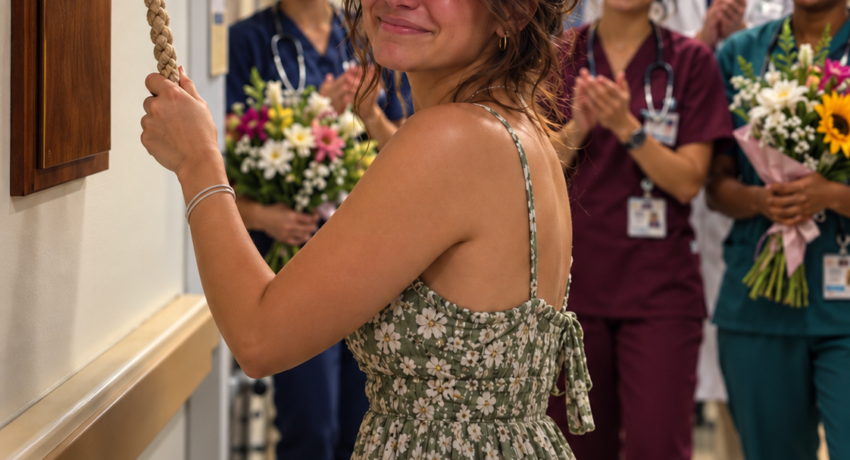
That Friday, I stood next to it in a green wrap dress I’d bought on sale for $64. It was the first nice thing I’d bought for myself in over a year. My hair had grown back just enough to need a comb.
I kept checking my phone.
“You nervous?” Sarah asked. She’d been my infusion nurse since my second round, and she knew exactly how I liked my warm blanket folded.
“Terrified.”
“Of a bell?”
“Of believing I actually get to live.”
She squeezed my arm. “Is your family coming?”
“All of them,” I said. “My mom, my sister, my brother. My dad, if anybody can find him.”
The ceremony was scheduled for noon. At 11:45, my phone buzzed.
Mom: Paige needs help with the kids. Sorry. See you later.
I read it twice. Then another one came in.
Paige: It’s just a bell, Nora. Don’t make such a big deal out of it.
Then a third.
Dean: Work’s crazy. Don’t make me feel bad.
Two days earlier, those same three people had filled our family group chat with hearts. Paige had promised to film it. Dean had promised to drive me home.
I stepped into the hallway by the vending machines and called my mother.
“You promised,” I said.
“Nora, you’re healthy now. Can’t you just be happy?”
In the background, I heard my sister laugh. Then I heard a cabinet close, the same squeaky one in Mom’s kitchen.
“You’re together right now,” I said. “All of you. And nobody could spare fifteen minutes?”
“Don’t start an argument.”
She hung up.
I stood there holding the phone against my chest. I could hear the soft beeping of an IV pump in one of the bays.
I’d thought the worst part of that day would be ringing the bell alone.
I was wrong. My family had been keeping something from me for seven weeks, and the only person willing to tell me was the man who had saved my life.
Part 2: The Girl Who Built Things
In my family, Paige was the smart one, and Dean was the athletic one. Mom kept their plaques and trophies on the living room shelf where guests could see them.
I was the one who liked sawdust.
At sixteen, I won first place in a regional woodworking competition for a walnut cabinet with hand-cut dovetails. I carried the trophy into the kitchen like it was made of glass.
Mom glanced at it while she stirred a pot of chili. “That’s nice, sweetheart. But have you thought about a real career?”
Dad lowered his newspaper. “Linda, she built that cabinet herself.”
“Richard, I’m thinking about her future.”
“So am I.”
Dad was a carpenter. I’d grown up in his workshop, sitting on an overturned bucket and handing him clamps. That night, I asked him why Mom couldn’t just be proud of me.
“She doesn’t understand what you do, kiddo.”
“And you do?”
“Of course. You make something out of nothing. That’s a gift.”
By twenty-eight, I owned a small furniture restoration business called Second Grain. I had a rented shop, a waiting list, and a sign on the door I’d painted myself. Mom still asked when I was going to get a respectable job.
“I already have one.”
“Making tables?”
“Linda,” Dad said quietly.
“It’s fine, Dad.”
Later, out by my truck, he asked why I let her talk to me that way.
“It’s easier than arguing.”
“Easier for who?”
I didn’t have an answer.
Dad never pushed. He just showed up. He picked up lumber for me and helped me deliver dressers. He also kept dreaming out loud about the barn at the country house, the old place outside Lebanon that had belonged to his mother.
“One day, we’ll turn that barn into a real workshop.”
“With two workbenches?”
“Three. I’m not sharing my tools.”
“And who’s paying for all that?”
He grinned. “Let me dream, Nora.”
That was the year the exhaustion started. Then came the pain, the tests, and a small, cold room where Dr. Harris folded his hands and said, “It’s cancer.”
My first words were, “But I have orders to finish.”
Dad came over that afternoon and sat on the arm of my couch. “Tell me what you need.”
“I don’t know.”
“Then we’ll figure it out together.”
Mom arrived the next day with groceries and a lecture about sugar and “workshop chemicals.” Paige called when her kids gave her a minute. Dean ran errands when he could.
But Dad came every single day.
“Appointment tomorrow?”
“Eight.”
“I’ll drive.”
“Dad, you have work.”
“And you have cancer. I win.”
Chemo flattened me. Some nights I couldn’t keep down crackers. Dad made chicken soup in my tiny kitchen and called my clients to push back deadlines. The one time I called Mom crying, she asked if Dad had visited, then told me to get some sleep.
After that, I stopped calling her.
One afternoon, Dad set a tiny carved bird on my nightstand.
“What’s this?”
“A very expensive piece of art.”
“It looks like a sparrow.”
“Then my artistic career is over.”
I laughed for the first time in weeks. “What if I don’t get better?”
“Then I’ll keep making you ridiculous birds.”
“Promise?”
“Promise.”
Six weeks before my final scan, Dad stopped coming.
Mom said he was swamped with orders. When his phone went straight to voicemail, she said he’d dropped it in a bucket of stain. A week later, she said he was helping relatives out of state.
“Which relatives?”
“Stop wearing yourself out with questions.”
“Why isn’t anybody else calling me? Not even Walter?”
Walter had been Dad’s best friend for thirty years.
“I told everyone you needed rest. Especially Walter.”
I was too weak to fight her. I told myself I’d drive to Dad’s the minute I was well enough.
Then Dr. Harris looked at my scans and smiled. “No evidence of active disease.”
I called Dad first.
It went to voicemail.
Part 3: The Envelope
When I came back from the vending machines, Sarah was waiting by the bell. She looked at my face and didn’t need to ask.
“Nobody’s coming?”
I shook my head.
“Okay,” she said. “Then we’ll get you a better audience.”
Ten minutes later, six people in scrubs were crowded into the hallway. A phlebotomist, two nurses, a pharmacist who’d mixed my chemo, Sarah, and Dr. Harris, holding a bunch of grocery store daisies still wrapped in cellophane.
I pulled the cord three times. It was louder than I expected. Everyone clapped, and the pharmacist whistled through his fingers.
“You earned every one of those,” Dr. Harris said.
Sarah hugged me hard. “Where are you headed?”
“My mom’s. Maybe they’re planning a surprise.”
She gave me a small smile. “I hope so.”
I was halfway across the lobby when I heard my name.
“Nora! Wait!”
Dr. Harris was jogging toward me, which I had never seen him do. He held a long white envelope.
My stomach dropped. “Is something wrong with my results?”
“No. Your results are fine.”
“Then what is it?”
He lowered his voice. “I’ve been debating whether to give you this. Your father’s attorney couldn’t reach you, so his office faxed it to the clinic two weeks ago. I put it in my desk drawer.” He swallowed. “After today, I think you deserve the truth about your family.”
The letterhead said Bennett & Ruiz, Attorneys at Law.
The first line made my knees go soft.
We regret to inform you of the death of your father, Richard.
I read the date three times. It was forty-nine days ago.
“That’s not possible. Mom said he was helping relatives.”
“Your father had a pulmonary embolism,” Dr. Harris said gently. “It was sudden.”
The letter listed a funeral date. It also listed an estate meeting I’d never been told about.
“Why didn’t anyone tell me?”
“Your mother called the clinic. She asked us not to upset you during treatment.”
I stared at him. “You knew. And you went along with it?”
He looked down at the daisies. “I believed she was acting in your best interest. I was wrong.”
“You should have asked me.”
“You’re right. I’m sorry, Nora.”
“Did he suffer?”
“From what I was told, it was very quick.”
“Did he ask for me?”
“I don’t know.”
I walked out holding the envelope so tightly that the corner tore.
It took forty minutes to get to Mom’s house. Paige’s SUV was in the driveway, and Dean’s truck was parked behind it. Through the front window, I could see silver balloons.
They’d found time to throw me a party. They just hadn’t found time to tell me my father was in the ground.
I opened the door.
“Surprise!”
Mom stood next to a sheet cake that said CONGRATS NORA in blue icing. Paige was holding a bottle of champagne. Dean was setting out paper plates.
I put the letter on the table, right next to the cake.
“Is Dad dead?”
The room went still. Paige set the bottle down very carefully.
“Yes,” Mom whispered.
“You buried him without me.”
“We were protecting you.”
“From saying goodbye to my own father?”
“Mom didn’t think you could handle it,” Paige said.
“So you all went to his funeral.”
Nobody answered.
Dean finally spoke. “I wanted to tell you. After the funeral, Mom said she’d talked to your doctors and the shock could set back your recovery. We’d just lost Dad, Nora. I couldn’t lose you too.”
“So you let me keep calling him.”
He stared at the paper plates. “Mom said we’d tell you after your final scans.”
“My scans came back clear a week ago.”
Silence.
I looked at my mother. “You knew I was waiting for him.”
“I’m sorry, Nora.”
“No,” I said. “You’re sorry I found out.”
I took the letter and walked out while they called my name.
I didn’t know it yet, but the party wasn’t the only thing they’d planned without me.
Part 4: The Maple Tree
The next morning, I drove to Cedar Hill Cemetery with the wooden sparrow in my coat pocket.
I wasn’t ready to forgive anyone. I just wanted a few minutes with my dad.
His headstone was under a maple tree that had already started turning orange. The dirt was still raw at the edges, and someone’s carnations had gone brown in a plastic cup.
“Hey, Dad.”
My voice cracked on the second word.
“I did it. My scans are clear.”
I set the sparrow on top of the stone, right above his name.
“You said we’d build something bigger together.”
I heard footsteps on the gravel behind me. Walter was standing there with a bunch of sunflowers, Dad’s favorite, wearing the same Carhartt jacket he’d worn for as long as I could remember.
“He’d be proud of you, kid.”
“I only found out yesterday. Nobody told me.”
Walter went still. “Linda told everyone you couldn’t come to the funeral because of treatment.”
“She never told me there was a funeral.”
He lowered himself onto the grass beside me with a grunt. For a while, neither of us said anything.
Then he asked, “Did Linda at least give you the keys?”
“What keys?”
“To the country house.”
“Why would she? It’s my parents’ house.”
Walter shook his head. “No, Nora. Your grandma left it to Richard. It was his. Just his.”
I stared at him. “He used to talk about turning the barn into our workshop. I thought he was just dreaming.”
“He wasn’t dreaming. He had me look at that roof twice.” Walter rubbed his jaw. “Sounds like somebody’s been keeping you in the dark. You need to call his lawyer.”
The torn envelope was still in my pocket. I found the number at the bottom of the letter and dialed before I could talk myself out of it.
“Mr. Bennett? This is Nora. Richard’s daughter.”
“Nora. Finally. I’ve been trying to reach you for over a month.”
“I’ve been sick.”
“Yes, your mother explained. She said you were too ill to deal with any legal matters.”
“I wanted to ask about Dad’s country house.”
“Your father left it to you,” he said. “He was very specific. He wanted you to have a woodworking studio there.”
“He what?”
“Probate is still open, so it hasn’t been formally transferred yet. Until then, the executor manages the property.”
“Who’s the executor?”
“Your mother. She received a copy of the will five weeks ago. She told us she’d go over it with you.”
“She didn’t.”
I thanked him and hung up. Walter didn’t say a word. He just put his hand on my shoulder.
A mother who had lied about Dad’s death to “protect” me was one thing. But a mother who had also hidden the will from me was something else entirely.
I drove straight to the country house.
Paige’s SUV was in the gravel drive. The porch was stacked with moving boxes labeled KIDS’ ROOM and KITCHEN in black marker. Two contractors were carrying boxes of vinyl plank flooring through the front door.
Paige came out holding a fan of paint chips.
“Nora? What are you doing here?”
“I was about to ask you the same thing.”
“We’re renovating. Michael and I are moving in with the kids.”
“Who said you could do that?”
“Mom.”
“This is my house,” I said.
She laughed, but it came out thin. “What?”
“Dad left it to me.”
Her smile disappeared. “No. Mom said Dad wanted it to go to whoever needed it most.”
“Have you read the will?”
“No.”
“I just talked to his attorney.”
Paige looked over at the contractors. “Can we talk about this privately?”
“Tell them to stop first.”
“Nora, we already paid deposits!”
“Then let’s call Mom.”
I dialed her myself.
“Come to the country house,” I said. “Now.”
Part 5: Made by Richard and Nora
Mom pulled in twenty minutes later. Before she’d even closed her car door, Paige was walking toward her.
“You said Dad wanted us to have this place.”
Mom looked past her at me. “Nora, let’s discuss this calmly.”
“Did Dad leave me this house?”
“Your father loved all of his children. I’m sure he would want Paige’s family to have a proper home.”
“That’s not what I asked.”
“Your sister has two kids. You have your business and your apartment.”
“Did he leave it to me or not?”
Mom hesitated. Behind her, one of the contractors set down a box of flooring and stopped working.
“He did,” she said. “But circumstances change.”
Paige turned to her slowly. “Wait. You knew?”
“I was trying to do what was best for everyone.”
“Then why didn’t you tell me about the will?” I asked.
“Because I knew you’d react exactly like this.”
“When did you find out?”
She looked at the barn. “Shortly after the funeral.”
I looked at the boxes on the porch. “And you still told Paige she could move in.”
“She needed somewhere to live!”
“You hoped I wouldn’t find out until her kids were already sleeping upstairs.”
Then I asked the question that had kept me up all night.
“Is that why you kept Dad’s death from me?”
Her chin trembled. “At first, I was terrified it would break you. I only wanted you to finish treatment.”
“And after you read the will?”
She didn’t answer.
“You weren’t protecting me anymore,” I said. “You were buying Paige time.”
“I thought you’d understand once you were better.”
“You let me keep calling my dead father so Paige could have his house.”
Mom looked away.
That was all the answer I needed.
Paige crossed her arms. “My kids were promised this house.”
“By someone who didn’t own it.”
“We’ve spent thousands on this place!”
“Then ask Mom to pay you back.”
“You’re being selfish!”
“I almost died, Paige. Dad died while I was fighting for my life, and not one of you would tell me.”
“We were just following Mom!”
“You’re adults.”
“Enough!” Mom said. “Your father would hate to see you fighting.”
I looked her in the eyes. “Don’t speak for him.”
She closed her mouth.
“You took away my chance to say goodbye to Dad,” I said. “You are not taking the last thing he wanted me to have.”
Paige’s eyes filled. “What about my children?”
“They deserve a home. Just not mine.”
I walked to the porch, where the contractors were pretending not to listen.
“I’m sorry, guys. Please stop working. I haven’t authorized any of this.”
The older one nodded and started packing up his tools.
Then I turned back to my mother. “You’re done making decisions for me.”
Probate closed three months later, and I moved into Dad’s house in early spring.
Paige still doesn’t speak to me. Mom leaves voicemails every couple of weeks. I listen to them, but I don’t call back. Not yet.
Dean came out on a Saturday in April with a nail gun and two boxes of shingles. We spent the whole day on the barn roof and barely talked. Around four o’clock, he said, “I should’ve told you,” and I said, “I know.” It wasn’t forgiveness, but it was the start of it.
While I was clearing the back of the barn, I found a tarp pushed behind an old cabinet. Under it was a cherry dining table, sanded smooth, with three of the four legs attached. Dad’s pencil marks were still on the fourth.
It took me five weeks to finish it.
When it was done, I flipped it over and carved four words into the underside:
Made by Richard and Nora.
Then I set the wooden sparrow in the center of it.
For most of my life, I avoided fights because I knew Dad would step in for me. He always did. Losing him taught me what I should have learned years ago.
I can stand up for myself. And I don’t need anyone’s permission to build the life I want.