Part 1 — The Porch Light
It began raining only minutes before they lowered my stepfather into the ground.
For some reason, I kept thinking Thomas would have found the timing amusing.
He had always been able to turn inconvenience into a joke. If the kitchen faucet leaked, he called it our “indoor fountain.” When the old station wagon refused to start one winter morning, he stood in the driveway, patted the hood, and announced that the car had apparently decided to take a personal day.
That was Thomas.
Even on the worst days, he somehow found a small patch of light.
So as rain soaked the shoulders of my black coat and my heels slowly disappeared into the soft cemetery grass, I found myself remembering his terrible jokes while watching his casket descend.
And somehow, that made losing him hurt even more.
Michael stood beside me, clearing his throat every few seconds.
Mara had wrapped both arms tightly around herself.
Noah stared straight ahead, his jaw clenched, as though keeping his face still was the only thing stopping him from falling apart.
I lowered my head.
“Thank you, Dad,” I whispered.
Thank you for the lunches with handwritten notes tucked beside our sandwiches.
Thank you for learning how to braid hair because I cried the first time you tried and accidentally tied half of it into a knot.
Thank you for staying up through fevers, science projects, heartbreaks, and nightmares.
Most of all, thank you for raising five children who did not share your blood and never once allowing any of us to feel like we belonged to you less because of it.
Thomas had not been my biological father.
But that distinction had never mattered inside our house.
He was simply Dad.
And he had been that from the moment I was five years old.
Part 2 — The Man Who Chose Me
The first time I met Thomas, he arrived carrying a worn pink teddy bear.
The bear had one button eye and an ear that leaned sideways.
Thomas crouched so we were eye level and held it toward me.
“Your mother says you’re very particular,” he said seriously. “This bear seems pretty demanding too. I thought you two might understand each other.”
I stared at him suspiciously.
Then I took the bear.
Thomas smiled.
“Hi, Pumpkin.”
That nickname stayed with me for the rest of his life.
My mother married him not long afterward.
For two years, we were the kind of ordinary little family I thought would last forever.
Then, when I was seven, my mother died after an accident on a rain-slicked road.
Everything changed overnight.
My grandparents came almost immediately.
They loved me, and I know now they believed they were doing the responsible thing. They spoke calmly about schools, bedrooms, routines, and how Thomas was “still young enough to begin again.”
Everyone seemed to assume he would let me go.
After all, I wasn’t his child.
Not technically.
Thomas listened without interrupting.
Then he looked across the room at me.
I was sitting on the couch wearing two different socks, gripping that battered pink bear against my chest.
Thomas turned back to my grandparents.
“She’s my daughter.”
My grandfather started to respond.
Thomas repeated it.
“She’s my daughter.”
That was the end of the discussion.
He never remarried.
Instead, somehow, our family kept growing.
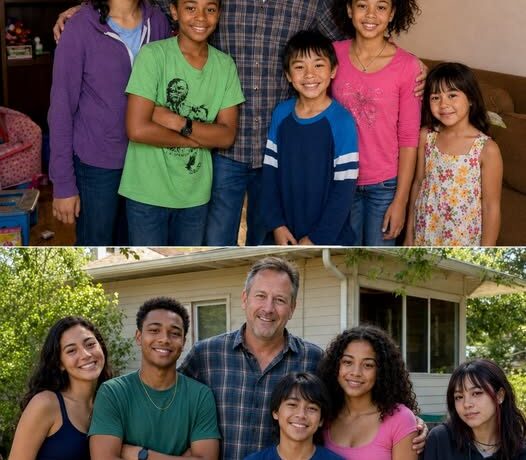
When I was nine, Thomas adopted Michael and Mara, twins who had spent far too much of their childhood moving between temporary homes.
Two years later came Noah and Susan, siblings who entered our lives through foster care and eventually became ours permanently.
None of us had the same beginning.
We didn’t have the same parents.
We didn’t share the same blood.
But Thomas built a home where none of that mattered.
At dinner, there were simply five plates around the table.
Five backpacks by the door.
Five children arguing over the bathroom.
Five voices shouting “Dad!” from different rooms.
Thomas never called us adopted children, foster children, or stepchildren.
We were just his kids.
And he was just our dad.
Part 3 — The Daughter Who Left
At the cemetery, I opened my eyes when Michael leaned toward me.
“Christina,” he murmured. “Susan came.”
My heart jumped.
I turned.
She stood alone at the far end of the gathering beneath a red umbrella.
For two years, I had imagined seeing Susan again.
I had imagined anger.
Questions.
Accusations.
Instead, the moment I saw her, all I felt was sadness.
She was only twenty, but something about her looked older.
Not her face exactly.
Her eyes.
They had the tired look of someone who had spent a long time carrying a burden alone.
I had left her a message when Thomas died.
I hadn’t expected a response.
But there she was.
Noah noticed her too.
“Go,” he said quietly. “Before she disappears again.”
I crossed the wet grass.
Susan watched me approach.
“You came.”
My voice barely worked.
She nodded.
“He was still my father.”
For one hopeful second, I thought that might be enough.
Then Mara appeared beside us.
“That’s all you have to say?”
Susan stiffened.
Mara’s grief had sharpened into anger.
“He waited for you, Susan. For years.”
Michael joined us.
“He sent birthday cards. Christmas cards. He called you. He left messages.”
Susan looked down.
Michael’s voice cracked.
“He left that porch light on every single night.”
I saw pain cross Susan’s face.
“I did what I thought I had to do.”
Mara turned away.
But I couldn’t.
Because I remembered the night Susan disappeared.
She had left one week after her eighteenth birthday.
No dramatic goodbye.
No shouting match.
Just a note on the kitchen table.
I found Thomas sitting alone on the porch with that note folded between his fingers.
His eyes were red.
I had rarely seen him cry.
“What happened?” I asked.
He handed me the note.
It said only that Susan was leaving, staying with a friend, and needed to build a life on her own terms.
“What does this mean?” I demanded.
Thomas stared into the yard.
“It means she’s gone, Christie.”
“Why?”
He remained silent for several seconds.
Then he said something I never understood.
“That isn’t my story to tell.”
When Susan finally answered one of my calls weeks later, I didn’t give her a chance to explain.
I was furious.
“You broke his heart.”
She stayed silent.
“You have no idea what you’ve done to him.”
Finally, Susan spoke.
“You don’t know Thomas the way I do.”
Then she hung up.
For two years, those words had bothered me.
At his funeral, I finally learned why.
Part 4 — The Wooden Box
A man in a charcoal-gray coat approached us as we stood beneath the rain.
“Thomas’s children?”
We turned.
He introduced himself as Mr. Elwood, Thomas’s attorney.
“He gave me very specific instructions,” the lawyer explained. “He asked that all five of you come to my office after the service. There is something he wanted you to receive together.”
Michael frowned.
“What?”
Mr. Elwood glanced toward Susan before answering.
“A box.”
An hour later, the five of us sat inside his office.
The room smelled like dark coffee, polished wood, and old paper.
In the center of Mr. Elwood’s desk sat a small wooden box with a brass lock.
Susan hadn’t said a word since leaving the cemetery.
Mr. Elwood pushed a tiny key toward me.
“Thomas asked that Christina open it.”
My fingers trembled as I inserted the key.
The lock clicked.
Inside were five envelopes.
One for Michael.
One for Mara.
One for Noah.
One for Susan.
And one for me.
Each name had been written in Thomas’s unmistakable handwriting, although the letters shook slightly from the tremor that had worsened during his final years.
Nobody suggested reading them aloud.
We instinctively turned away from one another, creating little islands of privacy in the same room.
I opened mine.
The first words made my heart stop.
“My sweet girl, there is something you need to understand about Susan. She left because she discovered a part of my past that none of you knew.”
I read the sentence twice.
Then I continued.
Thomas explained that Susan had once found an old heart-shaped locket hidden inside a desk drawer.
Inside the locket was a photograph.
Thomas stood beside a young woman.
Susan recognized her immediately.
It was her mother.
My hands started shaking.
Across the room, Noah had begun crying.
Mara covered her mouth with both hands.
Michael stared at his letter as though reading it again might somehow change the words.
And Susan…
Susan had gone completely pale.
Suddenly she stood.
Her chair scraped violently across the floor.
She folded the letter, shoved it into her coat, and ran from the office.
“Susan!”
I dropped mine and followed.
Part 5 — The Truth Susan Never Knew
I found her across the street beneath an enormous oak tree.
She had made it only that far before collapsing emotionally.
She bent forward, hands braced against her knees, sobbing so violently that her entire body shook.
It wasn’t the kind of crying you could hide.
It was grief mixed with guilt, shock, regret, and years of believing something that had suddenly been torn apart.
I wrapped my arms around her.
For once, she didn’t pull away.
“I was wrong,” she gasped. “Christie… I was so wrong.”
Michael, Mara, and Noah caught up moments later.
We formed a loose circle around her.
Susan reached into her coat and handed me Thomas’s letter.
“Please,” she whispered. “Read it. I can’t read it again.”
I unfolded the paper.
And finally, after two years of confusion, we learned the entire truth.
The woman in Thomas’s locket had indeed been Susan and Noah’s mother.
But she had not been his lover.
She had been his younger sister.
Her name was Elise.
Thomas wrote about how close they had once been.
Elise was adventurous, impulsive, stubborn, and desperate to escape the small life she believed was waiting for her.
At seventeen, she ran away.
For years, Thomas heard almost nothing from her.
He searched when he could.
He asked people who might know something.
Sometimes a postcard arrived.
Sometimes months passed without a word.
Eventually, even the postcards stopped.
Then, years later, Thomas received a letter.
Elise was sick.
She had two children.
She needed help.
Thomas went to find her.
But he arrived too late.
Elise had already passed away after an illness, and her children—Noah and Susan—had entered foster care.
Thomas began the process of bringing them home almost immediately.
He had never told us because he wanted Noah and Susan to decide for themselves how much of their mother’s story they wished to know.
But Susan had discovered the photograph before Thomas could explain.
She confronted him.
She saw a picture of the man who had raised her standing beside her mother and reached the worst possible conclusion.
Susan believed Thomas had once been romantically involved with Elise.
She believed he had abandoned her.
And worse, she came to believe he had later taken in Elise’s children out of guilt.
When Susan accused him, Thomas tried to explain.
But she was eighteen, devastated, furious, and convinced she had uncovered a lifetime of deception.
She refused to listen.
She left.
Thomas assumed she would calm down and come home.
But days became weeks.
Weeks became months.
And eventually, shame made the conversation harder for both of them.
Thomas continued sending letters and calling.
But he never forced the truth on her because part of him believed that when she was ready, she would ask.
She never did.
And he ran out of time.
Susan looked at Noah.
“He didn’t abandon Mom.”
Noah’s eyes filled again.
“No.”
Susan pressed one hand against her mouth.
“He was her brother.”
“Yes.”
“He was our uncle.”
Noah nodded.
“And he came for us.”
That final sentence broke her.
Thomas had not rescued Noah and Susan because he felt guilty.
He had brought them home because they were family.
Because they were Elise’s children.
Because when Thomas loved someone, he stayed.
Susan had spent two years believing the opposite.
Part 6 — Coming Home
“Come back to the house with us,” I told her.
Susan shook her head immediately.
“I don’t know if I can.”
Noah wiped his face.
Then, somehow, he said exactly what Thomas probably would have said.
“Dad would be furious if the five of us learned a family secret and then split up in a lawyer’s parking lot.”
Michael gave a wet laugh.
Even Mara smiled.
Susan stared at us.
Then a small, broken laugh escaped her too.
“Take me home,” she whispered.
So we did.
That evening, for the first time in two years, all five of Thomas’s children walked through the same front gate.
Susan stopped suddenly.
Above the porch, a single yellow bulb glowed.
The porch light.
Still on.
Thomas had left it on every evening since Susan disappeared.
Even during his final week, when climbing the stairs tired him and his hands shook too badly to open a jar, he still reminded me.
“Porch light, Pumpkin.”
Three nights before he died, he had caught my wrist as I helped him into bed.
“Don’t forget.”
“I won’t.”
“Just in case.”
I had known exactly who he meant.
Now Susan stood at the bottom of those steps staring at that little light.
Her face crumpled.
For a moment, none of us spoke.
Some grief doesn’t need words.
Inside, the house still smelled like Thomas.
Coffee.
Cedar.
Laundry soap.
And the cinnamon mints he carried in every coat pocket.
Michael immediately went into the kitchen.
That was his way of surviving difficult emotions—give him something practical to do.
Mara pulled the old photo albums from the cabinet.
Noah stood in the living room with tears running silently down his cheeks.
Susan sat on the couch.
She held the heart-shaped locket in both hands.
“I hated him.”
Her voice was almost inaudible.
I sat beside her.
“You were hurt.”
“I hated him for two years.”
“You believed something that wasn’t true.”
“I still left.”
I didn’t argue.
“Yes,” I said gently. “You did.”
Her eyes filled again.
“Do you think he knew I still loved him?”
“Yes.”
“How?”
“Because he knew you.”
She stared down at the locket.
“Do you think he’d forgive me?”
I looked toward the glowing porch light visible through the window.
“Susan, I think he forgave you before you even walked out the door.”
Michael entered carrying mugs of tea.
“Of course he did,” he said. “Thomas would’ve forgiven someone for stealing his car if they brought it back with a sincere apology and a full tank.”
Susan laughed.
It was the first real laugh I had heard from her all day.
Mara opened one of the photo albums.
“Oh, no.”
We gathered around.
There we were.
All five of us in matching Christmas pajamas Thomas had bought at a discount store and insisted were “exclusive European sleepwear.”
Noah was missing his two front teeth.
Michael had somehow managed to get chocolate on his forehead.
Mara was scowling because she hated having her picture taken.
Susan had bangs she had cut herself with craft scissors.
And I was sitting on Thomas’s shoulders, covering half his face.
Mara pointed at him.
“What was happening with his hair?”
Michael burst out laughing.
“He discovered hair gel and became dangerous.”
Even Susan smiled.
And for the next several hours, we remembered Thomas not as the man in the casket, but as the man who lived inside that house.
The man who burned pancakes.
The man who fell asleep during movies and denied snoring.
The man who showed up at every school performance whether we had one line or fifty.
The man who kept spare gloves in his car because one of us was always forgetting ours.
The man who had somehow convinced five children from completely different beginnings that they had always belonged together.
Part 7 — One Last Light
Three days later, we returned to the cemetery.
This time there was no rain.
The sky was pale blue, and sunlight moved through the trees.
Someone had already placed fresh flowers beside Thomas’s headstone.
Michael looked at Mara.
“You came earlier.”
Mara pretended not to hear him.
We all knew she had.
Susan approached the grave first.
She knelt.
For a long time, she simply rested her palm against Thomas’s name.
Then she began to cry.
There was no embarrassment left in it now.
No anger.
No attempt to protect herself.
Only love and regret.
“I’m sorry,” she whispered.
Her shoulders shook.
“I’m so sorry, Dad.”
I had brought something with me.
A small battery-powered lantern.
I placed it beside the headstone and switched it on.
Warm golden light appeared behind the glass.
Susan looked at it.
Her breath caught.
The porch light.
That was when she completely broke down again.
Noah knelt beside her.
Then Mara.
Then Michael.
I joined them last.
And there, around Thomas’s grave, I finally understood something he had been teaching us our entire lives.
Family is not created by matching names on birth certificates.
It is not guaranteed by DNA.
Blood can tell you where you came from.
It cannot always tell you where you belong.
Thomas had raised five children who were not biologically his.
One was his stepdaughter.
Two came through adoption.
Two were the children of the sister he had lost.
But Thomas never divided his heart according to those labels.
He packed five lunches.
Attended five sets of school conferences.
Lost sleep over five teenagers.
Celebrated five graduations.
Kept photographs of five children in his wallet.
And when one of those children ran away believing the worst about him, he did not turn off the light.
He left it burning.
Night after night.
Year after year.
Just in case she came home.
Susan reached for my hand.
Noah took hers.
Michael rested a hand on Mara’s shoulder.
For a long while, the five of us stood quietly around Thomas.
Then we began walking toward the road together.
Nobody walked ahead.
Nobody stayed behind.
For the first time in two years, we moved as five siblings again.
Exactly as Thomas had raised us to be.
Before getting into the car, Susan turned back once more.
The little lantern still glowed beside his headstone.
And I imagined Thomas saying the same thing that light had been saying every night since she left:
You may be angry.
You may be lost.
You may stay away longer than you intended.
But you still know the way home.
Because Thomas taught us something I hope none of us will ever forget.
Love isn’t determined by blood.
Sometimes love is simply the person who chooses you.
The person who stays.
And the person who keeps the light on until you find your way back.