I thought I knew every sacrifice my father had made for me. I knew about the engineering degree he never finished, the boots he glued back together, the sandwiches he pretended he’d already eaten. But one crumpled plastic bag proved there was a whole chapter of his life he’d been too afraid to tell me, and it led me straight to my mother’s backyard, where she was about to give a speech about the life she’d built “from nothing.”
Part 1: The Bag He Couldn’t Watch Me Open
“Daddy’s Bug, I hope you’ll forgive me after you see what’s inside.”
I read the line twice. Then I looked down at the wrinkled grocery bag in my lap, the kind you get for free at any checkout, and wondered what on earth my father could have put in it that needed forgiving.
Three hours earlier, I had buried him.
Now I was standing in the empty viewing room of the funeral parlor, still in my black dress, with Dad’s old construction jacket pulled over my shoulders. It smelled exactly like him: sawdust, burnt coffee, and the peppermints he kept stuffed in every pocket. I hadn’t been able to take it off since the cemetery.
Mr. Lewis, Dad’s lawyer, stood across from me with his hands folded. He was a quiet, gray-haired man who had handled Dad’s will, and he looked about as uncomfortable as I felt.
“Did he tell you what I’m supposed to forgive him for?” I asked.
“No. He only asked me to give you the bag after the funeral.”
“He could have just handed it to me himself. He had eight months.”
Mr. Lewis lowered his eyes. “He said he couldn’t watch you open it.”
That scared me more than anything else he could have said.
My father didn’t avoid things. He walked into thunderstorms to fix neighbors’ roofs. He argued with landlords and school principals and once, memorably, a bear of a man who’d cut in front of me in a lunch line. The only things Dad ever dodged were doctors and conversations about himself.
I tugged at the knot on the bag. It didn’t budge.
“Of course,” I muttered. “He tied it like he was expecting a hurricane.”
Mr. Lewis almost smiled.
I gave up on the knot and tore through the plastic with the tip of my car key.
To understand why my hands were shaking, you have to understand my dad.
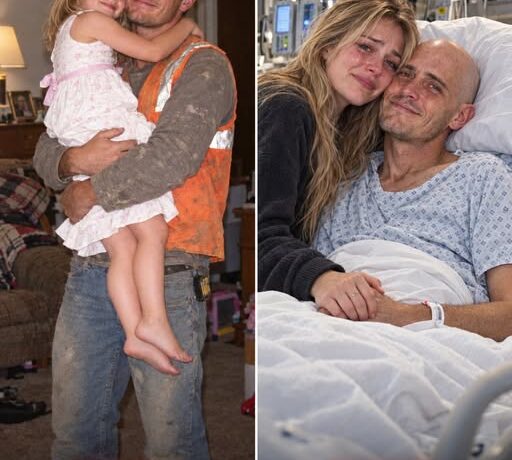
My earliest memories of him are pieces of his work: steel-toe boots lined up by the door, an orange safety vest draped over a kitchen chair, rough, calloused hands tucking the blanket under my chin at night.
When I was born, he was a college student studying engineering. He had plans. Bridges, he used to say, half-joking. He wanted to build things that would still be standing long after he was gone.
Then one Tuesday, when I was three, my mother told him she was running out for groceries.
She never came back.
The following week, Dad dropped out of college. He borrowed a hard hat from a friend, took the first construction job that would hire him, and raised me alone in the same cramped two-room apartment for the next twenty-two years.
Money was always tight. Dad glued the soles of his boots back on rather than buy new ones. He could stretch one pound of ground beef across four dinners. Once, when I was about eight, I caught him splitting his only sandwich in half and handing me the bigger piece while swearing he’d already eaten at work.
He hadn’t. I could tell.
Whenever I asked him why he worked so much, he’d kiss the top of my head and say the same thing.
“Because you’re worth every sore muscle, Daddy’s Bug.”
I promised him I’d pay him back someday. A real house with a yard. A vacation somewhere warm. Quiet Sundays where he didn’t have to do anything at all.
I never got the chance.
Eight months after his diagnosis, cancer took him.
The first thing I pulled out of the bag was a photograph.
It showed a sunny backyard with a wooden fence and a grill smoking in the corner. A man in a polo shirt stood with his arm around a woman, and on either side of them were two young adults, a son and a daughter, both grinning at the camera.
I barely looked at the man or the kids.
I was looking at the woman.
I knew her eyes. I’d seen them every single morning of my life, staring back at me from the bathroom mirror.
“That’s my mom,” I whispered.
She was older than the one blurry photo Dad had kept of her. Her hair was shorter, and fine lines had settled around her mouth. But there was no doubt in my mind. None.
The colors were too bright to be old. Down in the corner, a date was printed in small orange numbers.
It had been taken six months ago.
My mother hadn’t vanished into thin air. She hadn’t died in some tragic accident the way I’d secretly imagined as a little girl, lying awake and inventing reasons she couldn’t come home.
She was alive. She was smiling. She was standing in a backyard with a family.
I turned the picture over with numb fingers. Three names were written on the back in handwriting I didn’t recognize. A husband. A son. A daughter.
“She has a husband,” I said, and my voice didn’t sound like mine. “And two kids. She raised other children.”
“Simone…”
I looked up at Mr. Lewis, and the question came out before I could stop it.
“Did Dad know?”
He didn’t answer. He didn’t have to. The silence answered for him.
I shoved the photograph toward him like it had burned me. “My mother walked out to buy milk when I was three years old. Dad quit school the very next week. He worked construction until his back gave out and his knees were shot. And you’re telling me he knew she was alive?”
“Your father told me not to explain anything,” Mr. Lewis said quietly. “He said the truth had to belong to you.”
I stared at the torn bag in my lap. There was more inside. I could feel the weight of it: stiff envelopes, a thick bundle of paper, something long and rolled.
Whatever else my father had hidden from me was still in there, waiting.
“Then I’m taking it home,” I said.